9 Low-Budget Small Business Internet Marketing Tips
There’s no denying the significant role of digital marketing in business. It’s key to opening your business to a wider market. It also makes your brand more noticeable in a sea of competitors. It comes as no surprise that business owners blow thousands of dollars to follow the trendiest internet marketing tips to make more sales and win more customers.
While investing in marketing is definitely worth it, indiscriminately spending a lot of money on campaigns isn’t exactly a good decision. In fact, it’s not a feasible move at all for entrepreneurs who are working on a tight budget. So, how can you promote your products and win more customers with limited funds?
How much do businesses spend on marketing?
Being in the loop of things helps in making informed decisions – and in creating a marketing plan, it is no different.
The Manifest 2019 conducted a survey that studied 461 businesses on how much they spent on advertising. Check out the findings below:
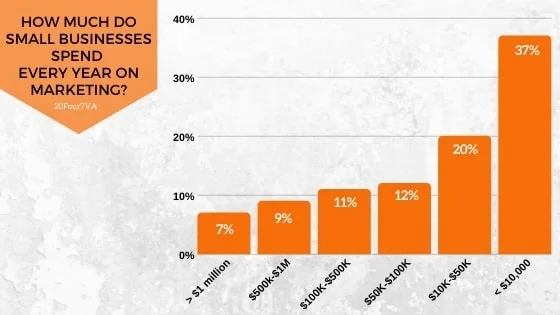
You don’t need thousands of dollars to be able to afford effective advertising. If you are financially practical when putting together your marketing strategy, even a small budget can go a long way. The following data can help you make smarter decisions:
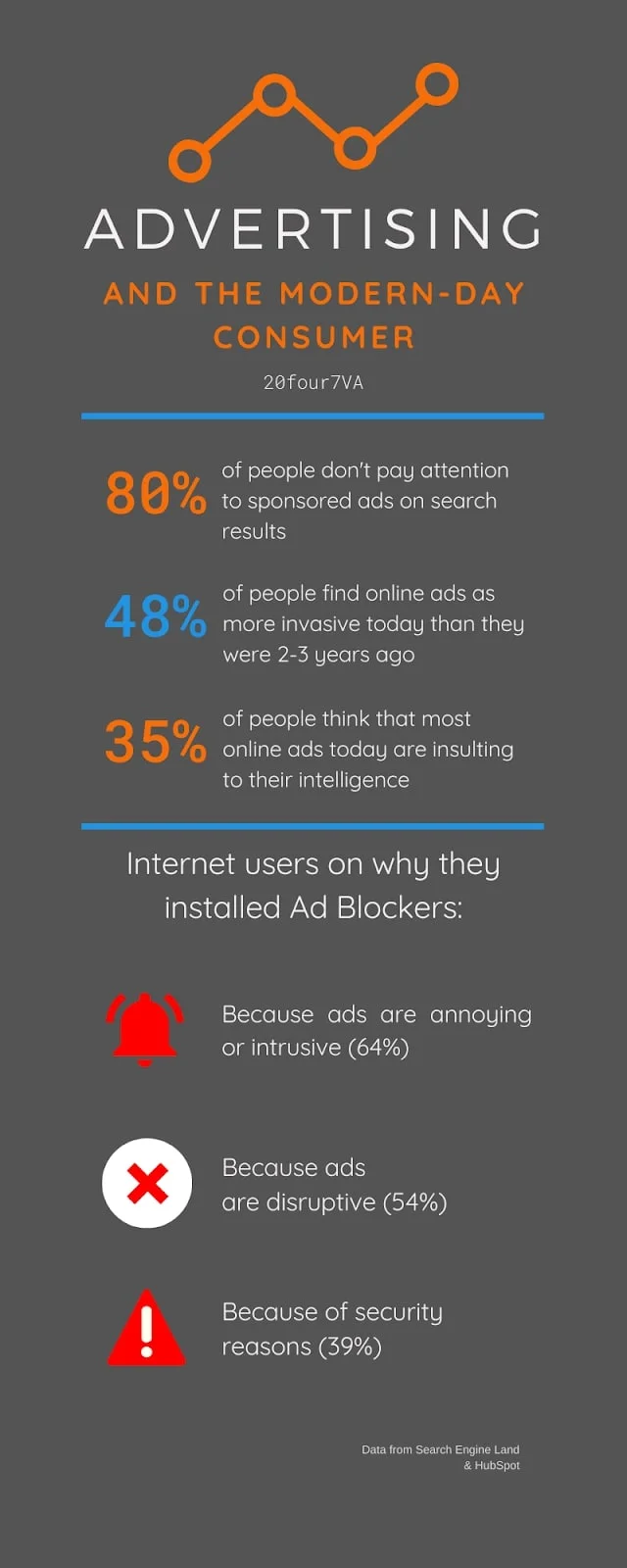
- 80% of people didn’t pay attention to sponsored ads in search results
- 48% of people thought online ads are more invasive today than they were 2 or 3 years ago
- 35% of people agreed that they find most online ads today as insulting to their intelligence
- When asked why they installed ad blockers, 64% of people said it’s because the ads were annoying or intrusive, 54% claimed the ads are disruptive, and 39% said security reasons.
These findings highlight the fact that while spending money on ads is important, costly marketing doesn’t necessarily equate to successful marketing. For one thing, consumers today are more discriminating when it comes to picking out brands to support. For another, creativity – not money – is the key to making an unforgettable marketing campaign. What’s more, a sound internet marketing plan is one that weighs your financial health into the equation.
Small Business Marketing Tips: How to Promote within Your Means
Put together a marketing action plan that is effective and financially practical. These low-budget online marketing tips should help you get there:
1. Keep investing in effective content.
Many advertising gimmicks have come and gone but content is as relevant as ever. This is even confirmed by a Havas study that revealed 84% of consumers expect brands to produce content. What’s even better is the fact that content costs 62% less than traditional marketing on average. So, how do you keep producing quality content?
Apart from keyword optimization, it’s also helpful to scour social media pages and customer correspondence to find trending topics. What are your customers’ main product questions? Create a How-To article or an instructional video out of these subjects. What issues frustrate your buyers? Put together a guide to resolve these concerns. Here are other money-saving content marketing tricks to try.
TIP: Investing in content also means working with a specialist. Hire a content writer to help you research, write, proofread, and edit your website content, blog articles, and social media posts.
2. Host an online contest.
Running contests on social media or blogs is a tried-and-tested way for businesses to create buzz. Because the people who follow your pages are already interested in what you have to offer, you don’t need to spend as much time and money to get them to take action. Besides, people can’t resist getting prizes or freebies, especially if all they need to do is click a few links or tap a few buttons.
Make sure to make an event out of the contest, too. Give people plenty of time to get ready and participate. Countdowns on your social pages also rouse excitement, so more people are enticed to participate. Don’t forget to post the results of the contest and highlight the winner.
3. Get involved in local events or trade fairs.
Whether you make money from home or have a brick-and-mortar store, getting involved in local events is a great way to create a name for yourself. You can participate in worthwhile causes or charity events, sign up in your local business community, and attend industry-related events.
Remember: marketing doesn’t always mean generating leads or posting flashy campaigns. It can also mean expanding your network, so industry authorities and other businesses recognize your brand. In a nutshell, getting involved in local events and trade fairs help establish your legitimacy as a company.
4. Apply to business awards.
When people go on Google to research products, they are greeted with so many search results pages with different business websites. How do you stand out? One way is to establish authority.
Nothing shows off authority as powerfully as awards. Research the kinds of recognition you want to be known for and submit your application to the corresponding award bodies. From Entrepreneur of the Year and Sustainability Awards to Best Small Business Innovation, you can bag different awards to bolster your brand. Because organizers publish the winner in their newsletters and digital pages, you get free advertising as well. Here’s a list of small business awards to consider applying to.
5. Utilize social media.
Social channels are some of the most important marketing tools today. They are cost-effective, targeted, and relevant. If studies are any indication, social channels have also become a reference guide for shoppers. People read Facebook reviews to determine if a business is credible. They browse Instagram photos to scrutinize a product, and they create shopping guides through Pinterest boards.
Leveraging this can be as simple as promptly responding to comments, mentions, and direct messages. What website do your target customers frequent? Being social media savvy also means knowing your strongest platform and funneling a good portion of your ad funds there. Here are 10 other social media tips for small businesses.
6. Make the most of Google reviews.
A brainchild of Google to help beef up business information, Google Customer Reviews is beneficial for both businesses and consumers. For businesses, it strengthens credibility and highlights product value. For customers, it’s an important determining factor in making purchase decisions. Remember, no matter how much you promote your products, buyers will always consider the advice of fellow buyers.
Google Customer Reviews have 4 main features: Survey, Badge, Seller Rating, and Opt-in. Display the reviews in your online store, particularly near the product image and features. You must also ensure that your reviews are mobile-friendly, so people can see it regardless of which gadget they’re using.
7. Optimize Local SEO.
The internet made it possible to market and sell to an international audience. Perhaps this is why many entrepreneurs work to bag customers from the world over. While making your brand global is commendable, marketing to a large audience can sometimes be tricky. Here’s one web marketing advice you don’t see as often as you should: pay attention to local search.
78% of local searches on mobile phones end up in offline sales. That’s a number you can’t afford to ignore. Help people find you by linking your exact location on Google maps. If you’re operating as a purely virtual business, you can still optimize local search by publishing posts with local themes or soliciting reviews from previous clients. Here are 3 more tips for local SEO success.
8. Post videos more often.
Video is one of the most popular forms of content today. People won’t often sit down to read a whole blog post, but a one-minute or three-minute video is enough to make them stop and pay attention. On Facebook alone, more than 4 billion videos are watched every day.
The good news is that you don’t necessarily need a team of professionals to record and put up winning videos. Even short ones like Instagram stories and Facebook live can harness thousands of views when done creatively and consistently. Instructional videos, local events coverage, and behind-the-scenes are money-saving but popular video content.
9. Expand through virtual staffing.
The bigger your company gets the more demanding work becomes. The task of marketing your brand online is no different. The traditional solution would be to either hire a new worker or delegate more responsibilities to existing employees. The former entails a lot of paperwork and money, while the latter can lead to substandard work output and low employee morale.
The best way to build a marketing team is through virtual staffing. When you hire a virtual assistant (VA), you get the opportunity to work with a specialist without breaking the bank. Because many VAs are experts in content creation, SEO, social media marketing, and graphic design, you no longer have to spend time and money for basic training. If anything, you get expert output, so you can improve your campaigns further.
The best web marketing tips create a name for your brand without burning holes in your pocket. Promote within your means by following these 9 low-budget internet marketing tips and tricks.
READ MORERecommended Reading: 5 Types of Internet Marketing You Need to Know
Online Marketing 101 for Small to Midsize Businesses

Small to midsize businesses (SMBs) have unique marketing requirements and challenges that traditional, large companies don’t encounter. As online marketing becomes increasingly necessary, the need for SMBs to find appropriate promotional techniques also grows. The problem is that many SMB owners don’t know where or how to start. Thus, many SMB owners find themselves stranded in marketing plans designed for bigger companies.
To help you navigate the tricky and dynamic world of digital marketing, you must put together an action plan backed up by data and use techniques especially made for your business.
Online Marketing Stats for SMB Owners
Broad questions such as, “what’s the best marketing gimmick right now,” or, “how can I make my customers buy more” can quickly lead you down the wrong path. For one thing, they just bring up more issues and questions. For instance, are the current marketing trends relevant to your industry? If so, how? What value can you give your customers to make them buy more? These are questions you always have to as yourself, as you’ll lose track of your specific goals and plans if you follow vague and generic plans.
Avoid getting tangled into schemes that lead your business nowhere. Start strong by doing the following:
- Ask better questions. How do I do online marketing for my brand? What can I do to make buyers stay loyal?
- Be in the loop. Consider the following facts and figures regarding the world of SMB marketing.
What are SMBs?
Small Business are privately owned companies with less than $50 million average yearly revenue that employ 100 or fewer employees.
Midsize Business are companies with average yearly revenues of more than $50 million but less than $1 billion employing 200 employees or fewer.
- 91% of consumers have visited a physical store because of an online experience
- 75% of mobile local searches resulted in foot traffic within 24 hours
- 60% of consumers research products or services on Google or other search engines prior to visiting a website
- 41% of consumers read reviews before making an offline purchase
- 59% of consumers claim promotional emails made them buy something
- 61% of emails are accessed on mobile gadgets
- 84% of consumers expect brands to produce entertaining, helpful, and promotional content
- 71% of people want to learn about products through their website content rather than traditional ads
- 72% of marketers admit content strategy or management is challenging
- 73% of brands believe social media marketing works
- 57% of shoppers admit social media influence their purchase decision
With its significance recognized by both brands and consumers, how do you wield online marketing to fast-track your growth?
[activecampaign form=68]
How To: Internet Marketing Guide for SMBs
There is no single formula for acing the dynamic and constantly changing world of digital marketing. That’s why it’s important to put together a DIY digital marketing guide backed by statistics and professional strategies.
Keep your goals and logistics in mind and create an action plan using these pro tips for marketing online:
1. Create relevant, shareable content.
Blogs, sales channels, email, and social media – with the wide variety of virtual platforms today, it’s tempting to promote your products everywhere. Talking about your products in every avenue possible increases your chance of getting new customers, right? Wrong.
Quality always trumps quantity when it comes to publishing content. While it is important to publish content regularly, churning out post after post without strategy will only push people away.
So, how do you create content that resonates with people while helping you brand? What prompts readers to share your posts to their family and friends?

Find the balance between what you want to say and what your target audience wants to hear. You can zero in on this area by going beyond the basic demographics of your target market (age, gender, location) and learning about their struggles, goals, or fears. In a nutshell, know what makes your target customer tick and find out how your brand and service can make their day or life better.
Content Pointers to Remember
- ‘Eavesdrop’ on your customers and readers. What are the common questions or issues that people mention in your social channels? What kind of blog posts get the most reaction and shares? Exploit these topics more by re-purposing them into blog series, webinars, videos, or eBooks.
- Work with a content writer. Hitting the spot between promotional and engaging takes marketing skill and writing expertise – two things that a proven content writer can offer. So, work with a content writer to transform your ideas into readable, shareable content.
2. Send winning emails.
With the popularity of social media, email marketing tends to be brushed aside and given little attention. Yet, 59% of consumers claim that promotional emails have prompted them to buy something. Don’t miss out on sales and customer acquisition because of generic, substandard emails. These kinds of messages are often routed into people’s Promotions inbox or worse, filtered into Spam.
According to a study by Sales Force, 64% of recipients decide to open an email based on its subject line. So, take the time to personalize your emails based on the recipient’s history or behavior to get them to open and read your messages. Here are other 6 keys to email marketing success.
3. Prioritize social media over traditional marketing.
Local TV stations in the US charge a minimum of $5 for a 30-second commercial per 1,000 viewers, while national broadcasts cost $115,000 on average. On the other hand, radio ads that run for a week range somewhere between $200-$5,000 depending on location. While TV and radio ads cost a lot, they do not always reach the right customers.
Social media, on the other hand, is free to use. You just create an account, input your business information, post photos, and link posts to your website without having to pay a single dime. In fact, this is what many startups and home-based businesses do.
Of course, if you want to reach more customers and increase your revenue through social media, you would need to balance organic marketing and paid advertising. Still, paid ads on Facebook, Instagram, and YouTube are significantly cheaper than the ones on TV and radio. What’s more, social media advertising is targeted. That is, the platforms give you control over ad demographics, so you can reach the right people in the right locations.
Because there are several social channels, you need to identify the specific sites that your target customers frequent to allocate your marketing funds and campaigns accordingly.
Cost of social media advertising in 2019

The general rule of social media posting is to publish 80% useful or engaging content and 20% promotional posts. This is another reason why working with a content writer is a must. Content writers can put together posts tailored for a specific social platform. Here are other ways you can increase brand awareness through social media.
4. Work with an expert.
The ease and convenience of marketing online make many entrepreneurs take on the task themselves. While this is doable and a great way to learn, there is too much at stake when you work without expert help.
The good news is, working with experts is also easy and convenient. For one thing, you don’t need to break the bank to get professional marketing assistance. For another, you can start ramping up your team to cover different branches of online marketing, from content marketing and social media to search and email.
The best way to go about this is to hire a virtual staff. Hiring a virtual assistant (VA) for different marketing niches is your best shot to work with a stellar team using your startup budget.
Building Your Marketing Team
- Project Manager to plan or create a digital content calendar. Of course, you can be the Project Manager while you’re still building your marketing team.
- Content Specialist to write and edit posts on your website, social media, and email. Content specialists can also write product descriptions in sales channels to expedite purchase decisions.
- Social Media Manager to schedule and publish posts on different channels as well as monitor and respond to communications made on social sites.
- Data Specialist to read or interpret and evaluate analytics reports from your marketing campaigns.
A digital marketing VA can also help you choose tried-and-tested processes to curate, distribute, and monitor your campaigns. As experts of the field, marketing VAs know how to navigate the technical side and the human side of advertising. By working closely together, you can create a marketing action plan that beats the competition, follows the rules of the game, and engages buyers.
Learning how to do online marketing takes a lot of practice, time, and patience. Make sure you’re putting in the time, money, and effort on strategies meant for small to midsize businesses like yours. Start creating your online marketing action plan by keeping these takeaways in mind, following these tips, and working with a virtual marketing team.
[activecampaign form=68]
READ MORERecommended Reading: How to Reduce Operational Costs for Small Businesses
5 Types of Internet Marketing You Need to Know
[vc_row][vc_column][vc_column_text css=”.vc_custom_1702386982738{margin-bottom: 0px !important;}”]
Consumer behavior and marketing channels are so closely related that they often affect each other. The evolution of marketing from print advertising in the early 90s to TV and radio broadcasting in the mid-90s, and then finally to internet marketing shows that.
Unlike traditional advertising that only consists of 4 categories (print, broadcast, phone, and direct mail), internet marketing is still evolving. In fact, online marketing is just as dynamic as the behavior of the consumers. As the demands and preferences of people evolve, internet marketing also takes on various forms.
What is internet marketing and why should you know about it?
Internet marketing, also known as web marketing or online marketing, is the collective term for promotional activities or campaigns carried out online. As the channels where these campaigns are conducted expand, internet marketing continues to grow.
Entrepreneurs need to step up their game and be constantly on the lookout for what’s new in the field so that their business doesn’t get left behind. It may sound tedious, but doing business today is virtually impossible otherwise. In fact, internet marketing has evened out the playing field when it comes to reaching out to consumers and increasing brand awareness.
[activecampaign form=68]
So, what are these branches of marketing that made the world a little smaller for both business and buyer? Have a look at the 5 types of internet marketing you need to know:
1. Search Engine Optimization
For several years now, Search Engine Optimization has been instrumental in putting many small businesses on the map. SEO is the process by which companies improve their websites and content so that their web pages get a high website ranking in Google and other search engines.
Why it’s important:
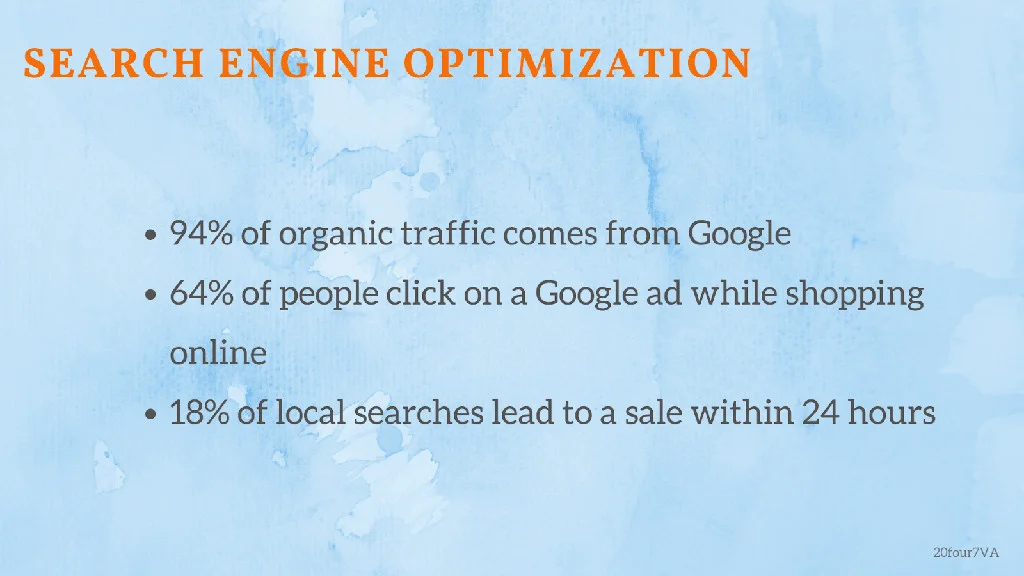
- 94% of organic traffic comes from Google
- 64% of people click on a Google ad when shopping online
- 18% of local searches lead to a sale within 24 hours
Because website marketing is the core of SEO, you can optimize your site by:
- Publishing industry-relevant and customer-centric blog posts
- Investing in local search
- Ensuring web pages load within 2 seconds
- Using a website design that looks great on all types of screens or devices
- Using title tags and meta descriptions
- Incorporating content with links to other pages of your blog
- Adding links to other relevant websites or resources
Recommended Reading: 3 Tips for Local SEO Success
2. Content Marketing
Content marketing is the process of creating and distributing engaging, useful, and keyword-enriched content to a target audience. The goal of content marketing is to build regular readership and push profitable actions including purchasing and content sharing.
Why it’s important:
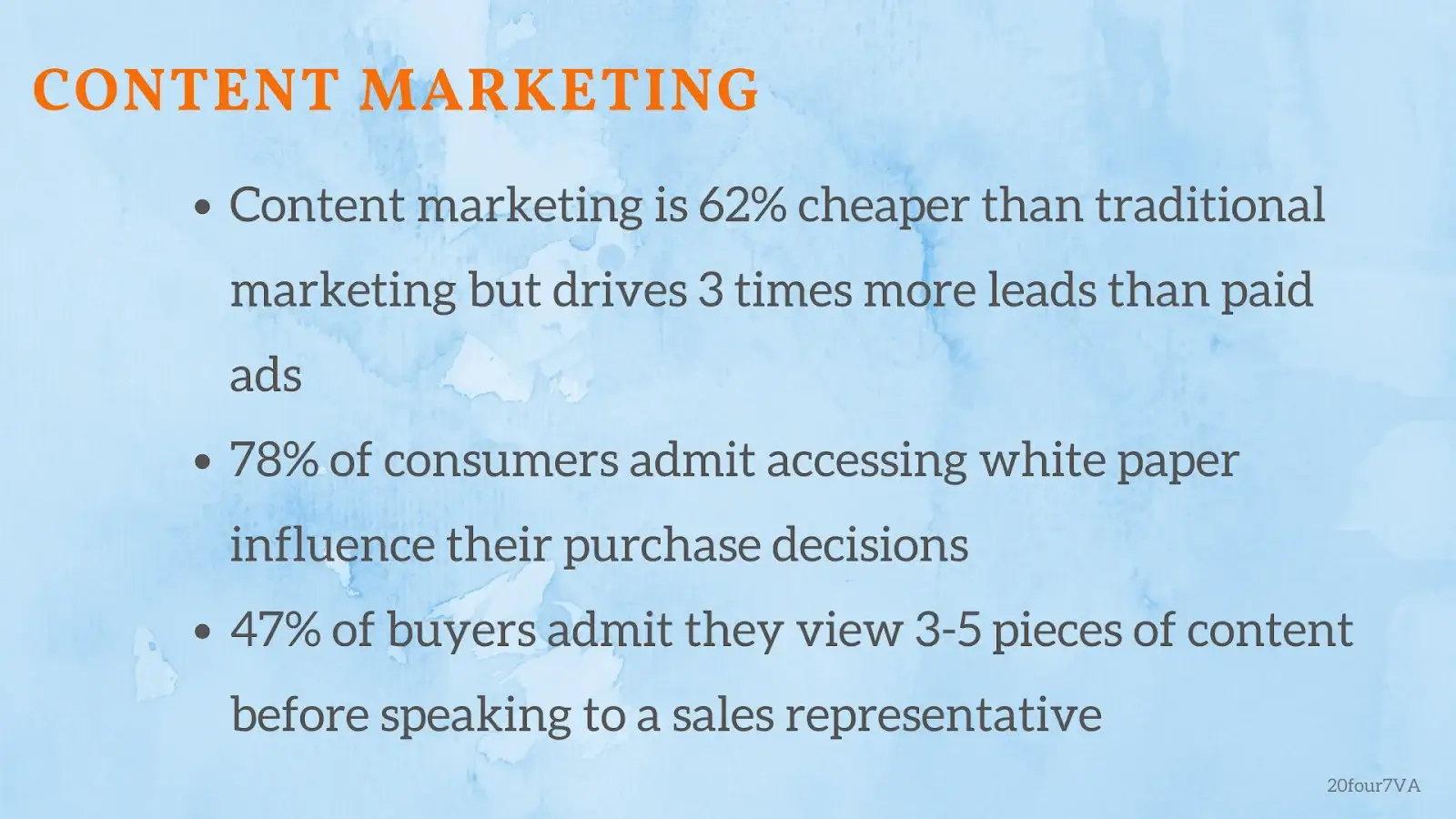
- Content marketing is 62% cheaper than traditional advertising but drives 3x more leads than paid ads
- 78% of consumers admit that white paper (content such as eBooks) influenced their purchase decisions
- 47% of buyers admit they view 3-5 pieces of content prior to speaking to a sales representative
Unlike paid ads that promote temporarily relevant campaigns, this type of marketing adds repeat value to a website or page. When done right, people will keep coming back to your page or share what they’ve read to others. These activities can bump a website higher in search engine results.
Below are some useful content marketing tips:
- Create a content calendar for a structured and regular posting plan
- Have a clear customer persona and create posts centered on their goals or pain points
- Research keywords that people mostly use when searching for your line of business
- Research industry-related news to post updated content and establish authority
- Invest on producing quality visual content (infographics, images, and videos)
- Re-purpose popular content into eBooks, webinars, videos, or social media posts
TIP: Work with a content writer VA to help you put together content that will fare well with both the search engines and the readers. Content writers are specialists when it comes to creating keyword-rich posts that make a good read.
3. Social Media Marketing
Initially created to help people keep in touch with long-distance family and friends, social media channels have snowballed into a huge marketing arena in just a few years. The aim of social media marketing is to increase sales, boost website traffic, and win more customers through channels like Facebook, Instagram, Pinterest, and Twitter.
Why it’s important:
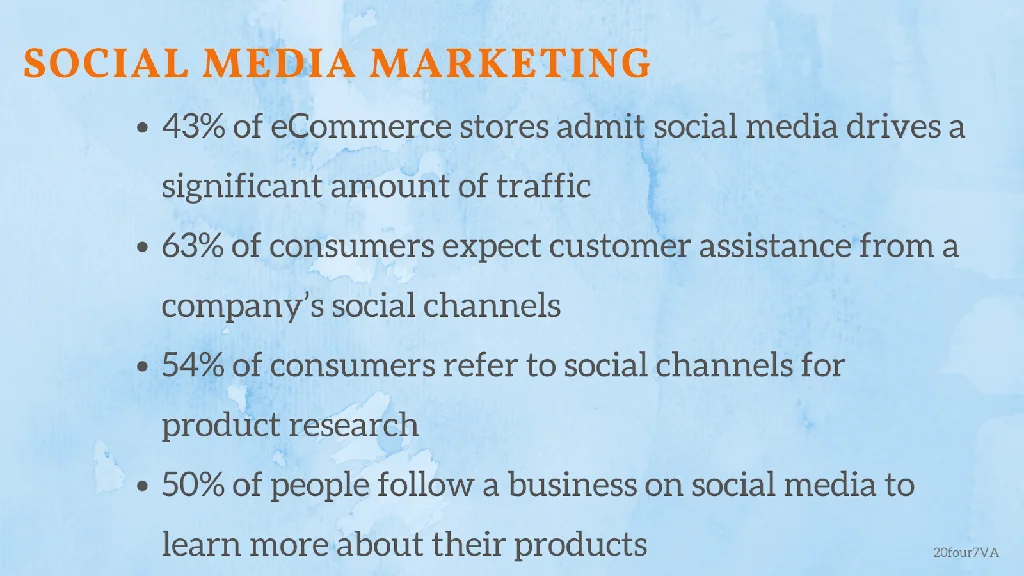
- 43% of eCommerce businesses admit that social media is instrumental in driving traffic to their online store
- 63% of consumers expect customer assistance from a company’s social channels
- 54% of consumers refer to social channels for product research
- 50% of people follow a business on social media to learn more about their products
The more social platforms emerge, the bigger social media marketing becomes. Here’s how to take charge:
- Research about the social media sites frequented by your target customers to know your priority channels
- Post engaging content regularly
- Respond to comments, mentions, and direct messages
- Consider your social channels as customer service platforms
- Hire a social media manager to schedule posts and reply to communications promptly
- Post links to your eCommerce store or blog posts
Social media is steadily becoming a central platform for brand and product research, that you can now take its influence offline. Here’s how to turn social media influence into in-store transactions.
Recommended Reading: A 4-Part Social Media Marketing Strategy for Beginners
4. Email Marketing
Email marketing has been around a long time, but the surge of social media has somewhat diminished its popularity. Perhaps because of limited funds, startups channel their investments to social media and search marketing instead of emails. Don’t make the same mistake.
Why it’s important:
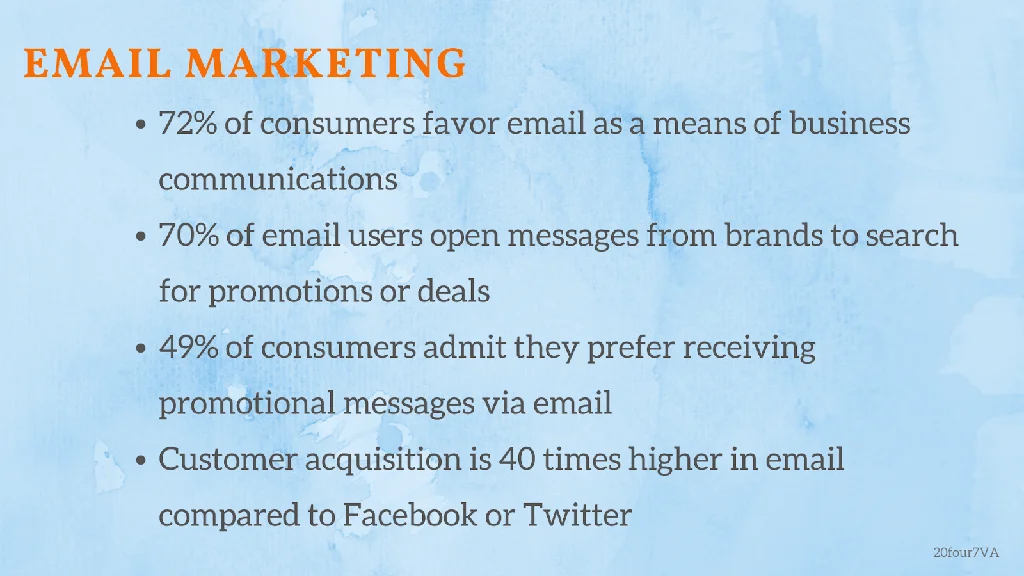
- 72% of consumers favor email as a means for business communications
- 70% of email users open messages from brands to search for promotions or deals
- 49% of consumers admit they prefer receiving promotional messages from their favorite brands via email
- Customer acquisition is 40x higher in email compared to Facebook or Twitter
Here are email marketing rules to keep in mind:
- Update your email list regularly
- Personalize your emails, from the To and From fields to the content and signature
- Mention a benefit or promotion within the first 20 words of your message
- Include a clear call-to-action
There are more email accounts than there are Facebook and Twitter profiles combined, so it’s only fitting to leverage email to your advantage. Besides, email marketing is significantly cheaper compared to other platforms. For instance, you can use providers like MailChimp to send up to 12,000 emails to 2,000 subscribers for free. Also, because email is easily integrated with other platforms, you can use it in combination with your social media and blog campaigns. Here are 6 other ways to achieve email marketing success.
5. Paid Advertising
As the name suggests, Paid Advertising is when marketers pay platforms like Google, YouTube, and Bing to display their ads.
Why it’s important:
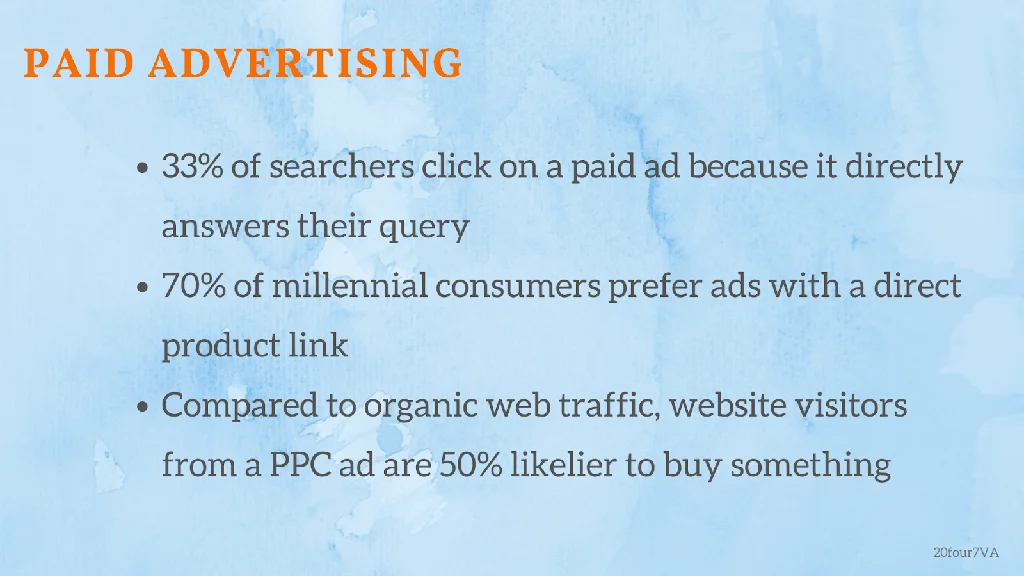
- 33% of searchers click on a paid ad because it directly answers their query
- 70% of millennial consumers prefer ads with a direct product link
- Compared to organic web traffic, website visitors from a PPC ad are 50% more likely to buy something
Paid Advertising is often used interchangeably with PPC (Pay-Per-Click), where brands pay a certain amount each time someone clicks on their ads. However, there’s more to this side of web marketing than that.
Here are the most common types of paid advertising today:
- CPA (Cost-per-action or acquisition) when brands are charged every time a user does a specified action or turns into a customer
- CPM (Cost-per-mille) when brands are charged after their ads hit 1000 views
- CPV (Cost-per-view) when brands are charged for every video view
BONUS:
Thanks to social media, another type of internet marketing is creating waves today: Influencer Marketing.
A straightforward and mutually beneficial process, Influencer Marketing is when brands collaborate with influencers to promote their products on certain platforms. Although they can also be mainstream celebrities, influencers are mostly people with a large following on social media or have an established authority in a specific niche.
Why it’s worth looking into:
- 89% of marketers report that influencer marketing is better or comparable to other marketing platforms
- 82% of consumers say they are highly likely to patronize brands recommended by an influencer they follow
- 49% of consumers say they depend on influencer recommendations for purchase decisions
The vastness of online marketing can be overwhelming. But if you want to raise brand awareness, increase your sales, and acquire more customers, you need to harness this ever-changing and ever-expanding tool. Knowing these 5 types of internet marketing is a great place to start.
[activecampaign form=68][/vc_column_text][/vc_column][/vc_row] READ MOREDigital Marketing vs Traditional Marketing
[vc_row][vc_column][vc_column_text css=”.vc_custom_1593066177168{margin-bottom: 0px !important;}”]There has been a long-running debate on what businesses should be using in their marketing campaign. Should every business turn to digital marketing? Should you do away with traditional marketing? To help you make a decision that works best for your company, here are some points of discussion regarding Digital Marketing vs. Traditional Marketing.Definition
To start off, it would be best to define what digital and traditional marketing is. This will give you a clear idea on the pros and cons of each marketing strategy. This would also provide you with some information on what your business should be using for its marketing campaign.
Traditional Marketing
Traditional marketing is often associated with tangible items such as posters, flyers, business cards, brochures, pamphlets, and magazine and newspaper ads. Mail, TV and radio ads are also associated with traditional marketing. How effective is traditional marketing? It’s this conventional marketing plan that has catapulted most big businesses we know to where they are right now.
Digital Marketing
Compared to traditional marketing, digital marketing is very young but promising. Examples of digital marketing include the following: websites, social media shares and mentions, and YouTube videos and the ads that come with hemt. Many small businesses turn to digital marketing to help grow their business. More on the whys later.
Why choose Traditional Marketing?
One of the biggest pros of traditional marketing is the personal feel. You get to interact on a personal level. Examples would include distribution of flyers, business cards, brochures, pamphlets, etc. While distributing the said materials, you also get to interact with potential customers. Since this type of interaction happens in a personal way, you get to receive questions and answer them right away. You also receive feedback from customers as well. Some customers prefer this type of interaction because they can gauge if the person in front of them is telling the truth. They can also clarify some matters if they wish to and get the answers right away.
Why not Traditional Marketing?
One of the biggest reasons is that it’s expensive. Your business will spend tons of money running this type of marketing strategy. Aside from spending on the production of materials and hard copies, you also spend resources in manpower. Print, radio and TV advertising can be very costly.
Why choose Digital Marketing?
The cost is not as high compared to traditional marketing. You don’t need to hire numerous employees to distribute your materials. You can hire virtual assistants or a virtual secretary to run your marketing campaign. Since your staff does not need to be physically present, “distribution” of materials is done through the internet. An administrative assistant or virtual assistant can handle your email marketing campaign or social media accounts.
One benefit that digital marketing brings to the table, that attracts small businesses and new businesses alike, is that it levels the playing field. A small business that has a well-designed eCommerce website can compete with known, big businesses. Another advantage is that in digital marketing, you can target a specific area or a local audience, and if you choose to go global, this can be easily done with a few tweaks and clicks.
Why not Digital Marketing?
Since businesses have seen the power and potential of the internet, specifically social media, it’s now uncommon to see a business without its own website or social media account. The competition is fierce. So in terms of staffing, you really need to have skilled professionals who know how to run a sound marketing strategy.
With the pros and cons listed above, you can now weigh in on what type of marketing strategy to use. The wonderful thing about this is that you’re not limited to using only one. Some businesses use both traditional and digital marketing to help their company grow and be successful. It’s just a matter of determining what works and what doesn’t in relation to your brand. Business owners should not put limits on strategies and tools that they can use to help the business grow. Take advantage of every opportunity. If you think that both strategies would work in accordance with your business model then go for it!
Next: 7 Email Marketing Tips For Small Business Owners
20Four7VA recognizes the challenge of effectively managing an online business – and we are very eager to help. Our company specializes in eCommerce VIRTUAL STAFFING SOLUTIONS, providing customizable and scalable solutions to small, medium, and large enterprise business owners so they can focus on growing their business.
Ready to have access to incredible people with incredible skills in the most cost-effective way? Give us a call at our toll free number 1 (443) 856-4882 today!
[/vc_column_text][/vc_column][/vc_row] READ MORE