Hiring a Virtual Assistant Best Practices: Part 1 – Screening, Hiring, and Onboarding

Hiring a virtual assistant is different from hiring an employee that you will be working with on-site. The absence of a face-to-face interview and the question of how to monitor a remote worker’s performance may deter some business owners. But as the thousands of entrepreneurs who have successfully worked with VAs will tell you, hiring for virtual assistant services doesn’t have to be daunting — not to mention the ton of benefits of hiring a virtual assistant.
Here are some essential tips for screening, hiring, and onboarding virtual assistants.
Screening and Vetting Virtual Assistant Applicants

After you’ve decided to hire a virtual assistant, the next step is finding the right person with the right combination of skills, competencies, work experience, and personality to help you grow your business. You need someone talented, disciplined, professional, and coachable. While you will find lots of highly capable and reliable virtual assistants, there are also not-so-good ones.
To weed out the bad apples from the good, follow these remote screening best practices:
Be clear about the job details.
Before you post a job ad, think about the tasks you need to delegate and the number of hours it will take to complete those tasks. In the job description, be specific about the work scope, the skills, and knowledge needed to accomplish the tasks, and the equipment and software (e.g., wired internet connection, Zoom, Photoshop) the VA should have (and know how to use).
Have a qualifying process in place.
You can’t draw conclusions about a candidate based on the resume or the preliminary interview alone. A multi-step screening and vetting process will help you identify the best candidate for the job. Your qualifying system may look something like this:
-
- Resume review
- A background check (run a Google search on the candidate, check the social media profiles, contact the references provided)
- Initial interview
- Systems check (internet speed, main and backup computer specs, etc.)
- Communication skills test
- Fundamental skills test (file management, email handling, phone support, etc.)
- Behavioral profiling
- Paid test task
- Final interview
If you have many applications coming in, a qualifying process will help you quickly remove any applicants who don’t have the skills and experience you need. Disregard any candidate who fails to follow instructions or who doesn’t meet your expectations at any point in the screening process.
Request verifiable references.
Do you check the references of applicants who will be working in your office? If the answer is yes, then you should also check the references of people you will be working with from afar. Remember that your VA will be immersed in your business and may handle company-specific data and information about you and your clients.
To ensure data security, you have to subject your pre-qualified candidates to a due diligence review. Ask them to provide verifiable references, look for feedback from previous clients, and check their online presence for potential red flags. If you’re hiring from a VA provider, ask for testimonials from other clients who have worked with the candidates you have shortlisted.
Ask the right questions.
In the absence of an in-person interview, a short audio or video call will help you identify applicants who can’t communicate clearly, who are vague about their actual work experience, and whose personality is not a good match with yours.
If possible, schedule a video interview. Try to keep it short and make sure you have scripted it carefully. Tedious and awkward interviews don’t paint a good picture of the work culture at your company.
Before the interview, prepare a list of questions. Ask about the candidate’s:
-
- Acquired skills
- Work experience
- Education
- Work environment
- Work habits
- Computer and internet situation
- Desired rate
- Current availability
- Inspiration, interests, and hobbies
Don’t forget to ask situational questions like “What would you do if you needed me to answer a question urgently but couldn’t reach me online?” These types of questions will help you get a good feel for who the best candidate is.
Give them a paid test task.
Once you’ve chosen your top candidates, pay them to do a short test task for you. Send each of them an identical task to be completed within a certain timeframe. This will help you identify those who were exaggerating their skills from those who are actually proficient.
Hiring a Virtual Assistant

How do you decide which candidate best fits the bill? Consider the following tips:
Create a candidate shortlist.
Don’t hire the first candidate who impresses you. Build a shortlist of at least three applicants before you hire your virtual assistant. You may be tempted to get the hiring process over with as soon as possible, but you deny yourself the opportunity to make an informed decision when you do.
Heading into the test task stage, you should have a pool of talent so that you can compare qualifications and have a diversity of skills, experience levels, and personalities to choose from.
Hire for attitude, train for skill.
Clients often make the mistake of hiring a VA online based solely on the skills, certifications, and credentials in their CV. Unfortunately, this doesn’t always ensure a successful hire. According to Leadership IQ founder Mark Murphy, 46% of new hires fail within 18 months. 89% of the time, the cause is attitudinal.
If the position you are hiring for does not require specific creative or technical proficiencies, consider hiring for attitude over skill. The idea behind this is that a person who has the technical and fundamental skills to do the job may not have values and goals aligned with yours. However, someone who is dedicated and has the right attitude can be trained to become productive.
A person’s emotional intelligence, disposition, and personality traits determine how he or she works, interacts with colleagues, tackles the work, and values your company.
Stay within your budget.
One of the top reasons for hiring a virtual assistant is the cost savings, so don’t go for the first candidate with an asking rate that seems reasonable.
Before you make a final decision, make sure that you’ve explored various options in terms of rate, service category, and years of experience. You might be surprised to find that you can hire a full-time virtual assistant at a third or less of the hourly rate in your area.
Offshore virtual assistants generally have lower rates than those located in the same country as the client. Freelance virtual assistants can also be less costly, but you may have to spend considerable time and resources to train them. A full-service virtual staffing provider will have offshore VAs who are pre-vetted and pre-trained, saving you time and money.
Aside from knowing how to hire a virtual assistant, you need to know where to hire a virtual assistant too.
Onboarding Your Virtual Assistant

So you’ve decided to hire a virtual personal assistant. Congrats! Now it’s time to prepare your virtual assistant and set him or her up for success. Here’s what you need to do:
Give them a warm welcome.
According to the Society for Human Resources Management, 69% of new hires are more likely to stay with an organization if they had a great onboarding experience. Clearly, making a good first impression is critical.
Just because your VA doesn’t work in-office doesn’t mean that you shouldn’t integrate him or her into the team. Onboard your virtual assistant in the same way you would welcome an on-site staff member. Make sure to introduce your VA to the rest of the staff and make time for a 1-on-1 meeting. This sets the tone for your working relationship and will help your VA become more invested in producing quality work for your company.
Provide an overview.
Before your virtual assistant starts, make sure that he or she has access to essential company documentation. These include the company profile, staff handbook, customer journey map, prospecting process, and buyer personas. These will provide valuable context on how your business works and who your customers are.
Set up a folder with all of the standard operating procedures, templates, forms, and guidelines your VA will need. Write out detailed instructions for how to perform each task. If possible, schedule a brief meeting to walk your VA through the instructional documents you prepared.
Start with a small project.
Even if you think you’ve gotten to know your new VA well, you should leave room for error. Before you go all in, test the waters by giving your VA small tasks and projects. This way, you’re not risking anything major until you’ve worked out any kinks and are certain that you and your VA are a good fit.
Once you have assessed the VA’s performance, you can start assigning bigger tasks. Over time, your virtual assistant should become an essential part of your business and grow into someone you can trust.
Final thoughts
The benefits of hiring a virtual assistant are countless. But you won’t reap those rewards if you hire a VA haphazardly. Keep in mind that it will take time and work to bring on a new team member. This is why it’s important to have good vetting, hiring, and onboarding processes in place.
Use the tips above to hire a virtual assistant online and equip your VA to become a vital member of your team.
READ MORE8 Reasons Expert SEO Copywriting Services Are Crucial to Your Marketing Plan

Search Engine Optimization (SEO) and copywriting are just two cogs in the marketing machine. But together, these two can turn any small business into a lucrative enterprise. Applying SEO tactics to fine-tune one’s marketing copy can convert online visitors into actual foot traffic to your physical store. It can blur the borders so that you can reach out and engage with audiences from all over the world. But while these are possible outcomes of SEO and copywriting, you must first have the right vehicle to get you there. Hiring professional SEO copywriting services is the key to turning your brand potential into a reality.

What is SEO Copywriting?
Although Google does not divulge its formula in ranking websites for search results pages, it’s well known that website traffic and time spent on a web page are huge deciding factors. The more people like what they see or read on your website, the longer they stay and the more pages they will explore. In the same vein, the higher you rank in Google’s search results pages, the better chance you have of increasing your website traffic.
SEO Copywriting is the art of writing content that scores well with both search engines and real readers. Years before, marketers would stuff a website with keywords without putting much thought into the overall readability and value of the content. As people become more cautious and knowledgeable about website content, SEO morphed into something more than just a list of keywords strung together. It has evolved to include engaging content that delivers factual and useful data.
In the same way, copywriting is more than just promoting one’s products and services online. It has become a craft that combines text, visuals, and technology to engage an otherwise impatient audience and convert passive readers into active brand supporters.

Why You Need to Work With an SEO Copywriting Expert
The mutually beneficial workings of SEO and copywriting have turned two marketing components into an industry. Yet not all business owners feel the need to get professional SEO copywriting services. For one thing, budget constraints can prevent businesses from affording the service of an expert SEO copywriter. For another, wearing many hats in their company is almost a default trait among entrepreneurs.
If you’re on the fence about paying for professional SEO writing services, these facts and figures are bound to make up your mind:
- 70% of people visit an establishment based on data they found online
- 53% of American consumers research products before making a purchase
- Blogs can bring about a 434% increase in indexed pages and 55% more website visitors
- 20% of internet usage is spent on content consumption
- 28% of local searches resulted in a sale
- 46% of Google searches account for local information
- 72% of people who searched for local business data visit stores within five miles
- 52% of bloggers admit it’s getting trickier to engage with readers
- 55% of website visitors only spend 15 seconds or less in reading articles
- 70% of consumers prefer reading articles over ads when getting to know a brand
Whether you take SEO copywriting seriously or not, it influences your business everyday. People spend time researching about a product or learning about a brand before making a purchase decision.
When you hire experts, you make an investment to ensure your target audience finds you and collects the right information about your brand.

8 Reasons Why You Need Expert SEO Copywriting Services In Your Marketing Plan
So, what exactly do professional SEO copywriters bring to the table? Here are 8 reasons why you need an expert to take over SEO copywriting:
-
They understand user intent.
There’s a reason for every Google search. User intent can be transactional, commercial, informational, or navigational. Search engines are now wired to predict user intent before a person can even finish typing their query. Professional SEO copywriters understand how this works. In turn, they can prepare a copy that would deliver answers to your target customer’s search intent.
-
They know how to find and use the right keywords.
Keywords are the currency that will rank your website in search results pages. An SEO copywriter expert knows the current trends and practices for leveraging keywords. As someone who has knowledge in SEO, for instance, they would know that a lot of Google searches have for or more keywords. As a writer, they would be skilled in weaving these words into a copy so it doesn’t sound forced. Having an SEO copywriter expert is an asset especially as your team expands. They can train other team members or share the best practices or tools to use such as the best free keyword research tools for SEO.
-
They craft powerful titles and eye-catching meta descriptions.
Landing the first page on Google’s search results is still not a guarantee that someone would click and open your link. People would browse through the search results and only read titles and those short, compressed sentences below them. Proper SEO copywriters understand that titles and meta descriptions are determining factors on getting a click-through or website traffic. They are skilled and trained to use these to your advantage.
-
They can affect the most compelling Call to Action (CTA).
You’ve collected the most relevant keywords. You have the most eye-catching titles and meta descriptions. After readers click on your page and read through your content, you would want to spur them into action. Do you want them to sign up to your newsletter, take advantage of a sale, invite others to your event, or share your post? Whatever your intent for an article is, how you phrase your CTA will determine the results. SEO copywriters know how to start, build up, and end content so that the reader will be roused to take part and happily take action.
-
They write content that engages readers.
According to Tech Jury, more than 4.4 million blog posts were published everyday in the first quarter of 2019. The same article also claimed that the average reading time is only 37 seconds. With millions of articles out there and less than a minute of reader attention, you have to offer exemplary content to stand out and hold the interest of readers. With odds such as these, you’re better off outsourcing copywriting to experts.
-
They have content format down to pat.
Do you need to educate your customers on how to properly use your products? Perhaps you have an upcoming promotion that requires mechanics and special instructions. Writing educational materials can be tricky. You can end up writing a long article that wouldn’t hold people’s interest or focus. SEO copywriters know how to format content in a way that captures and holds a reader’s interest. They can incorporate visuals or breakdown an otherwise complex piece of information so that people will remember it. In addition, they also know just the right number of words to make an article rank high in search engines while keeping readers’ attention.
-
They establish authority in your line of business.
As people get savvier with technology, they are becoming more aware and cautious of baseless content and downright fake news. If you want to be a credible brand, you must establish authority in your line of business. SEO copywriters thoroughly conduct research and fact-check posts before publishing them. They can deliver content with credible resources that allows people to verify the information and even expand their reading. Linking to credible external sources also shows how much time and effort was invested in creating a post. Linking to other pages in your own website signifies how much you know in your niche. SEO copywriters know how to use and capitalize on external and internal links to establish brand authority.
-
They provide strategic input.
SEO copywriters do more than just creating articles that rank high in search engines. They can research content from your top competitors and inspect their weak spots and strong points. They can utilize the best tools that analyze website visitor behaviour to see what content performed well or needs improvement. Then, they can organize this data into a report that will be shared to your team for discussion and planning. A high-impact article can be maximized by reworking it into a blog series or social media posts. Comments and inquiries from readers can be pooled together to use as content ideas.
How to Get Professional SEO Copywriting Services
The good news is, you don’t have to stretch your wallet to get the best SEO copywriting services. You can afford to hire an SEO copywriter — and even expand your team in the long run — by hiring virtually.
Hiring virtual SEO copywriters have been a popular choice of businesses for years. Most SEO copywriter virtual assistants (VAs) are adept in their niche and well-versed in the proper tools for research, writing, editing, publishing posts on schedule, and collaborating with others remotely.
By hiring from a full-service agency like 20four7VA, you also harness other perks of remote staffing. This includes having the staffing agency to take care of pre-screening VAs, recruitment, VA management, and payroll.
This leaves you with more freedom and time to work with your SEO copywriter to brainstorm ideas, strategize, and grow your brand with top-notch content.
READ MOREHow Virtual Customer Service Keeps Businesses Afloat During The Pandemic

The pandemic has affected different industries in different ways. At the core of the new standards of business operations are two options: you can either let the pandemic estrange or strengthen your customer relations. While there are plenty of ways to ensure your business survives the economic downturn, establishing a virtual customer service needs to be on top of your list.
What is Virtual Customer Service?
Sometimes referred to as Digital Customer Service, Virtual Customer Service is providing customer care, assistance, and solutions over digital channels. Instead of helping customers face-to-face, brands answer queries or solve issues through:
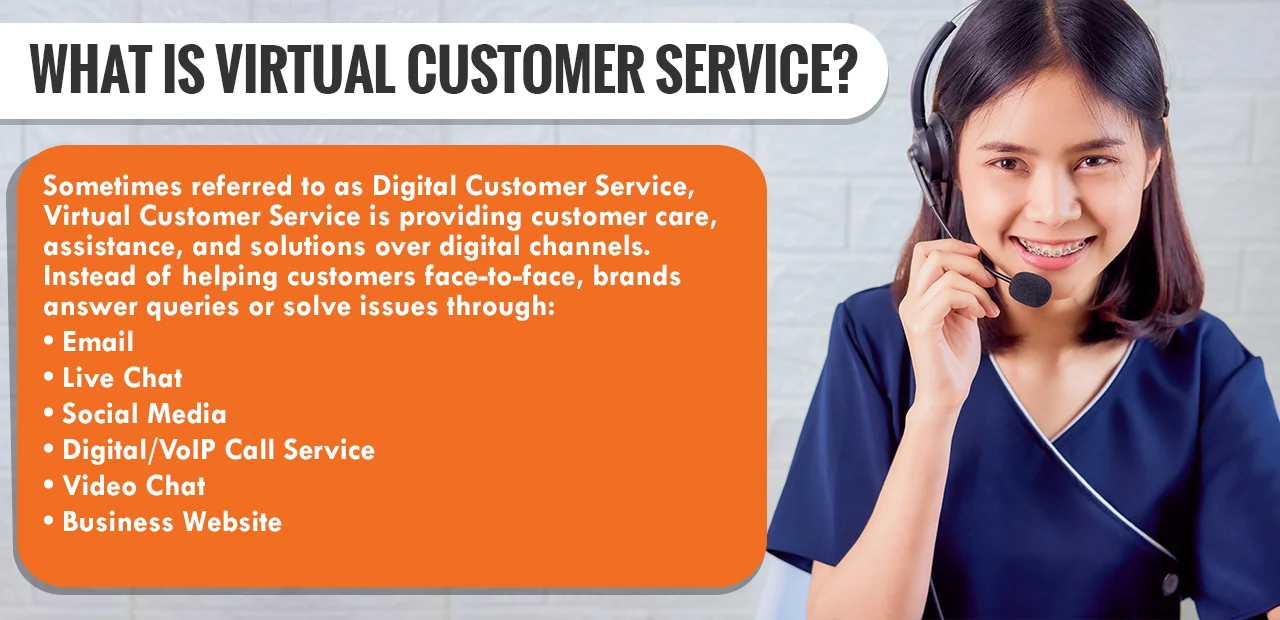
- Live Chat
- Social Media
- Digital/VoIP Call Service
- Video Chat
- Business Website
Other than answering customer questions or fixing problems, a virtual customer service associate can also handle other responsibilities.
Here are 27 other tasks that you can outsource to your customer service virtual assistant:
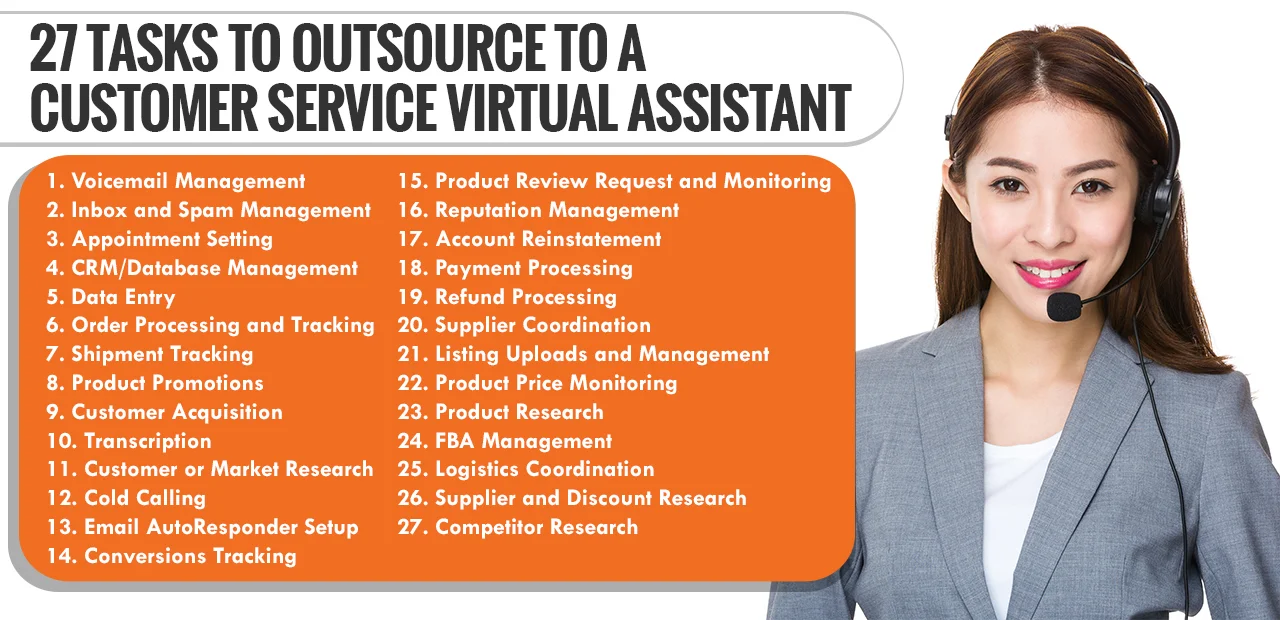
- Voicemail Management
- Inbox and Spam Management
- Appointment Setting
- CRM/Database Management
- Data Entry
- Order Processing and Tracking
- Shipment Tracking
- Product Promotions
- Customer Acquisition
- Transcription
- Customer or Market Research
- Cold Calling
- Email AutoResponder Setup
- Conversions Tracking
- Product Review Request and Monitoring
- Reputation Management
- Account Reinstatement
- Payment Processing
- Refund Processing
- Supplier Coordination
- Listing Uploads and Management
- Product Price Monitoring
- Product Research
- FBA Management
- Logistics Coordination
- Supplier and Discount Research
- Competitor Research
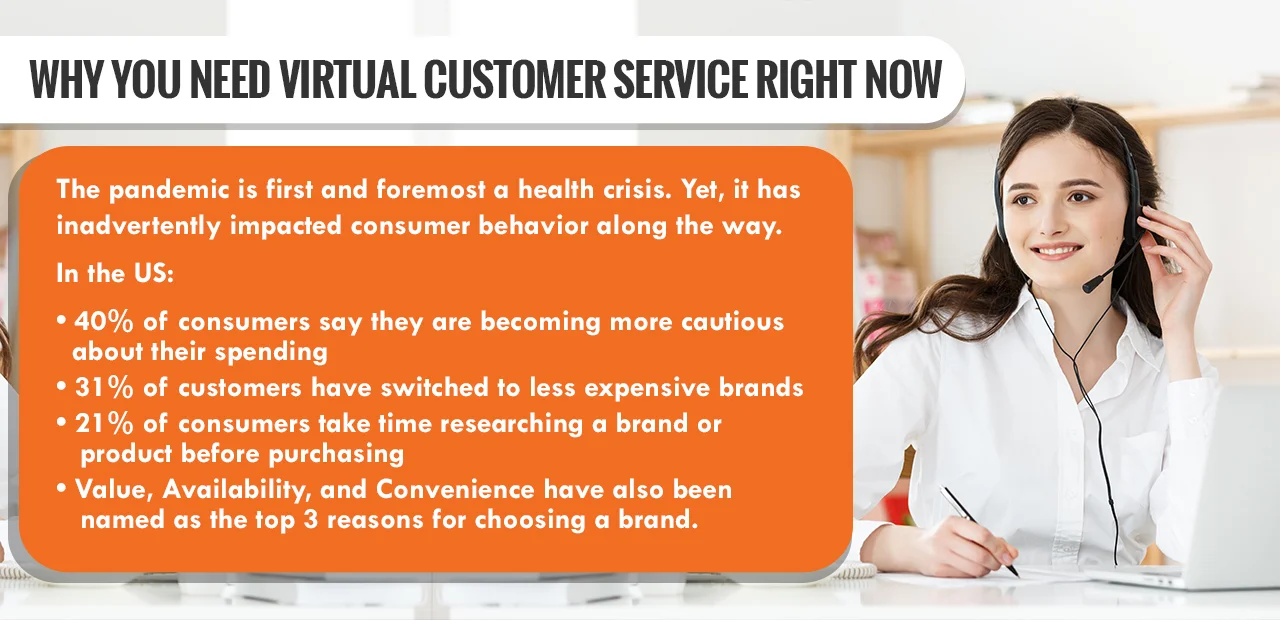
Why You Need Virtual Customer Service Right Now
Even as brick-and-mortar stores are slowly coming back, people remain cautious about switching to their normal, outdoor routines. For one thing, positive cases still turn up every day. For another, many people are still grappling with unemployment or reduced work hours.
The pandemic is first and foremost a health crisis. Yet, it has inadvertently impacted consumer behavior along the way.
In the US:
- 40% of consumers say they are becoming more cautious about their spending
- 31% of customers have switched to less expensive brands
- 21% of consumers take time researching a brand or product before purchasing
- Value, Availability, and Convenience have also been named as the top 3 reasons for choosing a brand. (Source)
Fortunately, these are also the top 3 benefits of virtual customer service. But how exactly can it help your business stay afloat during the pandemic?
7 Ways Virtual Customer Service Can Keep You In Business During The Pandemic
Here are 7 ways that virtual customer service can keep you in business:
-
It’s preferred by customers.
Customer experience should be at the core of how you conduct business. A study by McKinsey has revealed that in most countries, over 70% of consumers admit that they are not comfortable going back to outdoor activities yet. But just because people are keen to stay at home doesn’t mean the business has to stop. The same research also revealed that customers are now proactively looking for companies with visible safety measures and sustainable solutions. Many consumers have no qualms in switching to a different brand if such a brand can conveniently answer their queries or solve their problems without them having to leave the safety of their homes.
-
It expands your customer reach.
As the coronavirus pushed many establishments to close down or reduce operations, disruptions in supply chains have become inevitable. As a result, some products or brands are not readily available in the market. When customers cannot find or reach their regular service providers, they turn to other brands that offer the same products or services. Having a virtual customer service does not only ensure continuity for your business. It also offers you an opportunity to win over new customers by being readily available.
-
It can significantly reduce your operational costs.
The decline in sales as fewer people leave their homes, rising supplier costs, and extra expenses for safety materials such as masks for employees, regular disinfection, and store barrier installations — these are only a few effects of the pandemic that can greatly take a toll in your finances. As a business owner, you need to be strategic in handling your finances now more than ever. Virtual customer service can significantly reduce your operational costs without compromising brand value. By switching your customer service online, you no longer have to foot the bill for infrastructure, utilities, and other expenses that come with brick-and-mortar operations. Here are 5 business expenses you can reduce when you hire a virtual customer service representative.
-
It gives you access to expert service.
You have higher chances of finding more qualified people if proximity is taken out of the equation. Because customer service associates are the face or voice of your brand, it only pays to hire the best. Besides, customers nowadays are more knowledgeable and can spot amateur customer service easily. Hire people with the proper training and relevant work experience to get the job done well by finding customer service representatives virtually.
PRO TIP: Take it up a notch by working with a staffing agency to help you in the hiring and recruitment process. 20four7VA can help you find the best virtual customer service associate for your business. 20four7VA is a full-service staffing agency, which means that it will take care of employee training, supervision, management, and payroll for you. You have more breathing room in your finances and day-to-day operations if these responsibilities are taken off your plate. -
It embodies a caring economy.
People now buy more from companies that care about their employees. This is yet another interesting and significant consumer behaviour that came about because of the pandemic. Buyers are generously supporting companies that do not risk their employees through face-to-face interaction. Switching to virtual customer service ensures you remain on the good side of your customers while keeping your employees safe at the same time.
-
It increases productivity.
The work-from-home setup has become even more popular because of the pandemic. As news of unemployment and health risks proliferate, people are becoming more driven and committed to working virtually. By hiring customer service associates online, you are more likely to end up working with motivated and dedicated people. What’s more, people are bound to put in their best work when they have the flexibility of working in their hours and the convenience of working from home. If you are still working with regular, in-house staff, hiring virtual assistants can ease the workload from your local team. Apart from increased productivity, virtual customer service will inadvertently result in lower staff turnover.
-
It scales with your business.
The economy is on a turbulent trend. While many establishments and schools have already opened their doors, health and security risks still loom heavily in the air. Local and national governments can push new laws that will change business outlook overnight. With variabilities such as these, you can’t afford to affix yourself in a frigid business solution. Virtual customer service is thankfully as flexible as it is reliable. Perhaps you need to reduce working hours because of curfews or low sales. Maybe you only need help on certain days a week. Your customer service VA can work on your schedule and only be paid by their clocked hours. If you’re preparing for seasonal sales, you can also get an extra pair of hands to help with the expected increase in workload.
Final Thoughts On Virtual Customer Service
Although the pandemic has caused mass lay-offs and anxiety, it has also revealed the ingenuity of entrepreneurs as well as their affinity towards customers and employees.
Aside from offering curbside pickups and contactless deliveries, hosting virtual events, and sharing advocacies on social media, businesses have adopted creative ways to keep operations going, support employees, and cater to customer needs.
CareSignal went beyond providing their normal patient monitoring service and launched COVID Companion, a CDC-based educational and support program with location-specific health recommendations and resources.
Sal’s Pizza offers make-your-own pizza kits so patrons can store up and enjoy their favourite pizzas while cooped up inside the house. In addition, the company also offers special pricing for customers that share photos of their favourite Sal’s pizza using the hashtag #PizzaWithaPurpose.
A.K.A Kitchen shares online videos of how the business is keeping their employees and customers safe.
Although virtual customer service is a sustainable, scalable, and reliable business solution, you still need to be strategic on how to use it to strengthen customer relations and grow your brand. Simplifying order process and refund requests, pausing paid subscriptions or offering free trials, and being upfront about what customers can expect from your business are just some of the ways that you can inspire loyalty from people.
Virtual customer service is only one of many business solutions that you can adapt in response to the pandemic. Yet, the value it can add to your business will carry on into the future, even after you’ve resumed to normal operations. It will keep your brand relevant and keep your customers excited about your products or services. Through virtual customer service, people will identify you as a reliable brand that has responded and adapted to their needs in the trickiest of times.
READ MOREExecutive Assistant vs Administrative Assistant: What’s the Difference?
[vc_row][vc_column][vc_column_text css=”.vc_custom_1632475485445{margin-bottom: 0px !important;}”]
If you’re thinking about getting help in managing your business, then you’re bound to decide between getting an executive assistant vs administrative assistant. Having appropriate support can spell the difference between managing a business and barely getting by. You’re better positioned to focus on your core responsibilities, pursue your business ideas, and have an equally satisfying personal life with an executive or administrative assistant to share the workload.
But which type of assistant does your business need exactly?
What is an Executive Assistant vs Administrative Assistant?
Executive and administrative assistants are perhaps two of the most frequently sought jobs in any company. It’s common to have the two terms used interchangeably as there are similar and sometimes even overlapping roles and ideal qualities between these job titles.
However, there are key differences between an executive assistant vs administrative assistant. Learning to distinguish between these roles should help you decide which is more suited for your business.
Key Difference Between Executive and Administrative Assistant:
Executive Assistants (EAs) provide support for an executive or a team of executives in a company. Although the circumstances of every business vary, EAs typically provide direct support to high-level members of a company. This includes the CEO, president or vice-president, and CFO or chief financial officer of a company. At its core, the role of an executive assistant is to act as the right hand of the boss.
Administrative Assistants (AAs), on the other hand, are responsible for maintaining the day-to-day organizational and clerical tasks of an entire department or business. The Bureau of Labor Statistics defines Administrative Assistants as the people who “support other staff”.
Administrative Assistant is such a generic title that there are different types of roles under this job umbrella. In fact, the Bureau of Labor Statistics identifies an Executive Assistant as a high-level Administrative Assistant. Suffice it to say that people who are planning to become an executive assistant, should start out as administrative support in their career path.
[activecampaign form=68]What to Delegate: Core Responsibilities of Executive Assistant vs Administrative Assistant
You are better off performing your managerial duties through delegation of low-impact tasks pertaining to an executive. In the same way, you can empower others by giving them responsibilities that will challenge as well as hone their skills. Of course, the tasks you delegate would depend on whether you are working with an executive or administrative assistant.
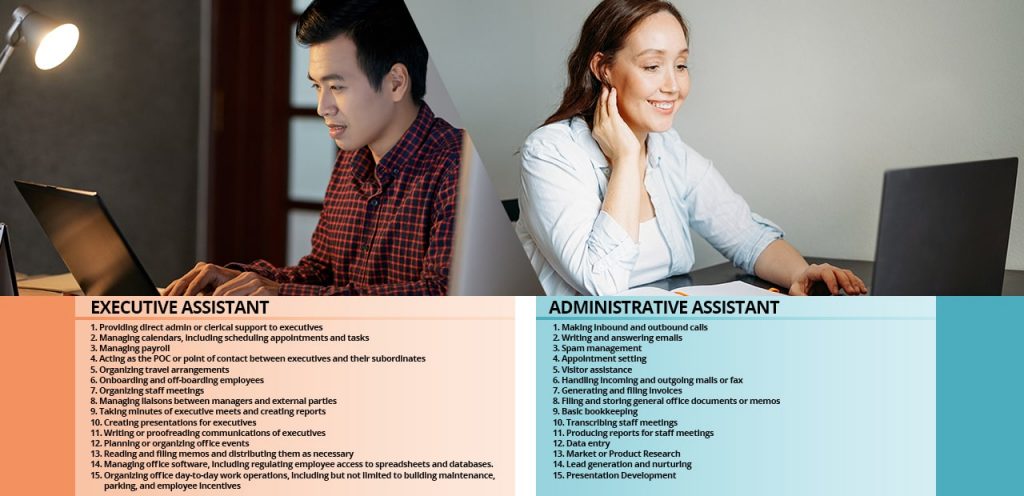
An Executive Assistant supports high-level personnel by doing the following tasks:
- Providing direct admin or clerical support to executives
- Managing calendars, including scheduling appointments and tasks
- Managing payroll
- Acting as the POC or point of contact between executives and their subordinates
- Organizing travel arrangements
- Onboarding and offboarding employees
- Organizing staff meetings
- Managing liaisons between managers and external parties
- Taking minutes of executive meets and creating reports
- Creating presentations for executives
- Writing or proofreading communications of executives
- Organizing office day-to-day work operations, including but not limited to building maintenance, parking, and employee incentives
- Planning or organizing office events
- Reading and filing memos and distributing them as necessary
- Managing office software, including regulating employee access to spreadsheets and databases.
An Administrative Assistant helps an organization by handling these responsibilities:
- Making inbound and outbound calls
- Writing and answering emails
- Spam management
- Appointment setting
- Visitor assistance
- Handling incoming and outgoing mails or fax
- Generating and filing invoices
- Filing and storing general office documents or memos
- Basic bookkeeping
- Transcribing staff meetings
- Producing reports for staff meetings
- Data entry
- Market or Product Research
- Lead generation and nurturing
- Presentation Development
What to Look For: Key Qualifications and Skills of Executive and Administrative Assistants
Education
When looking for Executive Assistants, many employers are inclined to hire people who have a 4-year degree. People who have educational and career backgrounds in business are also favoured. Over the years, as more small businesses come into existence, the number of online courses for executive assistants have also increased. This helps people obtain more marketable skills and give a leg up to those who don’t have the educational and career background for the role. These courses include Project and Time Management, Business Strategy, and Software Skills.
Companies looking to hire Administrative Virtual Assistant require people to have a high school diploma or an associate’s degree in business-related fields. Just like hiring executive assistants, companies are also inclined to work with people who have previous administrative roles in their careers.
Executive Assistant Core Skills
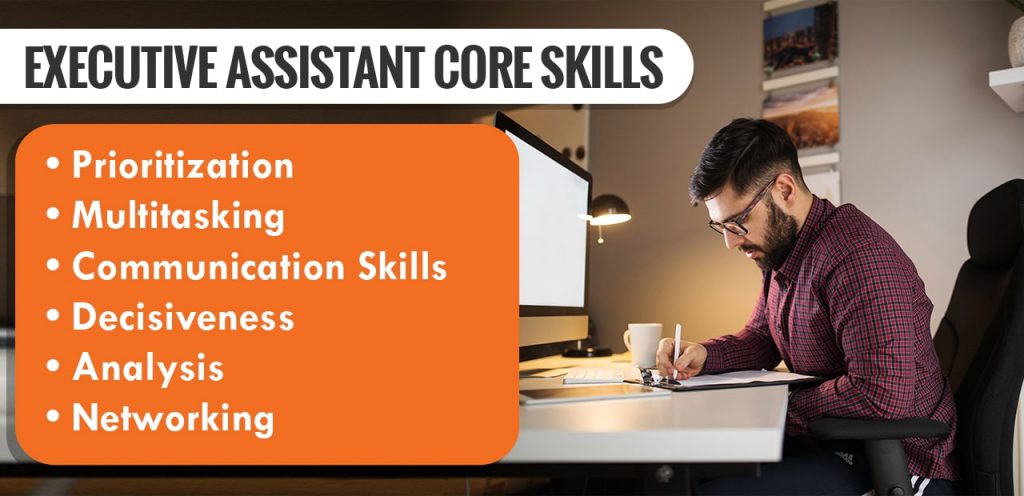
When looking to hire an EA, look for people who have the following competencies:
- Prioritization. Business executives have a lot on their plate. EAs should know to line up responsibilities and appointments according to urgency and importance.
- Multitasking. Multitasking should go hand in hand with prioritization. EAs should learn how to strategically and effectively perform multiple tasks following a timeline.
- Communication Skills. As the acting liaison officer for executives, EAs must be proficient in verbal and written communications.
- Decisiveness. Executives sometimes let their EAs decide in their stead. An effective EA should know how to make the right choices, especially under pressure.
- Analysis. The ability to make a sound decision is a by-product of someone’s analytical skills. An EA should possess such a skill to help executives move the company forward.
- Networking. As assistants to executives, EAs must have the proper networking skills to liaise and build beneficial connections whether it’s with investors, partners, suppliers, and clients.
Administrative Assistant Core Skills
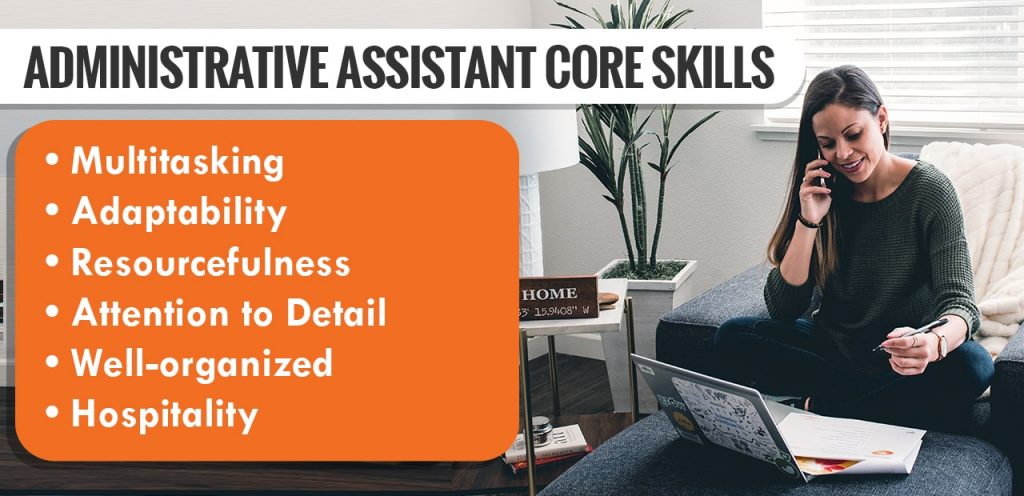
An administrative assistant excels in their role when they possess certain skills. Make sure to look for these competencies when looking for one:
- Multitasking. Admin assistants juggle a myriad of tasks for different people. They should be able to do so without anything falling through the cracks.
- Adaptability. Shifting between different schedules and tasks is inevitable when running a business. Admin Assistants should learn how to cope at a moment’s notice.
- Resourcefulness. Time-sensitive tasks and high-pressure situations are typical of a growing business. Admin Assistants must have the skills in ironing out the kinks in such situations.
- Attention to Detail. Effective admin assistants should be quick to notice typographical errors, remember multiple deadlines, and understand instructions with minimal instructions. Such a skill makes a whole operation run smoothly.
- Well-organized. Administrative assistants are there to help other staff perform their jobs well. To do so, an admin assistant must have a system in getting a myriad of tasks done while strictly following a schedule.
- Hospitality. Admin assistants are usually at the frontline of business communications. They should have a service mindset when communicating with different parties whether it’s through phone, email, or in person.
TIP: Integrity and confidentiality are also important traits for both Executive and Administrative Assistants. Both roles are required to handle sensitive company information and intellectual property. People who aspire to work as an EA or Admin support must have these characteristics for the role.
3 Tips for Hiring Executive Assistant or Administrative Assistant
1. Know what type of assistant you need for business.
-
- Small establishments usually have various team members act as both executive or admin assistants. Alternately, they can have one person perform both roles, while the business owner or executive takes care of tasks like managing payroll, communicating with partners and vendors, and organizing their own travel arrangements.
- Medium establishments or small establishments that are expanding need executive assistants to help high-level team members to carry out tasks. Medium establishments can have executive staff perform administrative tasks simultaneously or as situations demand it.
- Large establishments or businesses with a steady stream of clients or are working with multiple vendors are better off hiring both executive and administrative support. The EA can tend to the many duties of executives while the admin support takes care of the day-to-day operations of the business.
2. Hire virtually.
Hiring a virtual executive and administrative assistant is increasingly becoming the norm — and for good reason. For one thing, the pandemic has created profound economic changes that pushed many businesses into online operations. For another, virtual assistants prove to be an affordable and effective staffing solution for both virtual and brick-and-mortar establishments.
PRO TIP for virtual recruitment: Hire an administrative assistant through staffing agencies. 20four7VA pre-screens and trains VAs so that you can expect your administrative VA to provide a wide range of support from customer assistance to operations management and business improvement.
Another advantage of hiring from staffing firms is that most take care of recruitment groundwork and management of the VA. This includes pre-hire screening, interviews, training, onboarding, payroll, and employee coaching. Businesses will have a better breathing space when these responsibilities are taken off their plate.
3. Use the best tools in the market.
Whether you’re working with an EA or admin support (or both), your staff should have the best tools at their disposal. Here’s a big list of remote work tools that will help you from project management and marketing to security and communications.
An EA provides direct support to executives while admin staff mainly take care of clerical tasks of the entire team. Both are essential in making a business run smoothly and eventually expand. Knowing the difference between an executive assistant and administrative assistant as well as the various responsibilities and core competencies of each one should help you decide which type of support your business needs.
[activecampaign form=68] [/vc_column_text][/vc_column][/vc_row] READ MOREWhat’s The Difference Between Outsourcing and Offshoring
[vc_row][vc_column][vc_column_text css=”.vc_custom_1645597302712{margin-bottom: 0px !important;}”]
Businesses across the globe are slowly readjusting to the new industry and economic trends brought by the modern workplace. Now more than ever, people have come to realize the importance of remote work and digital business operations. As you chart a new course for your company, it’s crucial to start with understanding the key differences between outsourcing and offshoring. Knowing the differences between outsourcing and offshoring, both principal terms in virtual working and management, will help you pivot into the right digital direction.
What is the Difference Between Outsourcing and Offshoring?
One quick search on remote working or collaboration will pull up articles and studies that mention outsourcing and offshoring. Although the words are interchangeably used at times, there’s a basic distinction between these two business models.
Basic Difference
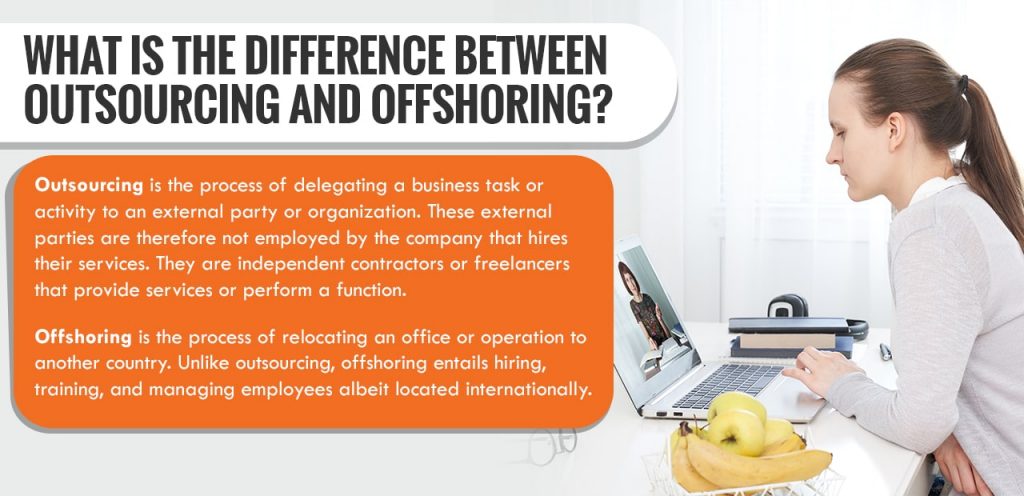
Outsourcing is the process of delegating a business task or activity to an external party or organization. These external parties are therefore not employed by the company that hires their services. They are independent contractors or freelancers that provide services or perform a function.
Offshoring, on the other hand, is the process of relocating an office or operation to another country. Unlike outsourcing, offshoring entails hiring, training, and managing employees albeit located internationally.
Suffice it to say that a business can outsource locally and internationally. Offshoring, however, can only be done and considered as such by extending a business process to a foreign location.
Of course, the difference between these two business models runs beyond the geographical extent. To recognize their distinctiveness further, it’s best to look at outsourcing and offshoring in terms of their main purpose as well as their respective benefits and drawbacks.
Main Purpose
Outsourcing processes to a third-party is often done by businesses to increase productivity while reducing operational costs. Just have a look at these 5 business expenses you can reduce by outsourcing to a virtual assistant.
Businesses often outsource low-impact tasks such as data entry and admin duties. By spinning these activities off to external parties, the company will have more time and resources to redirect to its core competencies. These days, however, outsourcing specialized tasks such as graphic design, content writing, digital marketing, software development, and more is becoming more prevalent.
TIP: You can outsource a business process by directly hiring a remote assistant or working with a staffing company such as 20four7VA to help you find one. Check out this infographic that outlines the key distinction between direct hiring and partnering with a staffing company.
Outsourcing has become a popular solution for solopreneurs and startups that juggle with the mounting work of building a business from the ground up. For example, a solopreneur with no blogging skill can outsource content writing to a virtual assistant to help them gain an online presence. An eCommerce owner can hire a sales agent to help process increased orders from seasonal sales.
Although it is outsourcing that is sought for short-term projects and by small businesses, its popularity extends to big brands. Apple, for instance, is one global brand known for outsourcing its manufacturing work to China. AT&T is another established company that outsources its customer and IT services to the Philippines.
Offshoring is a business move made by companies to reduce sourcing and labor costs. Companies often relocate their manufacturing work to foreign locations with cheaper raw materials, labor fees, and upkeep. By moving one’s operations to developing countries, a company can churn out more products and take advantage of more competitive pricing.
Although ethical dilemmas have clouded offshoring in the past years, globalization has helped resolve most of these issues. What’s more, several companies have already proven how offshoring can be an upstanding business solution.
Canva is a popular platform for digital design that has expanded its operations to the Philippines. According to the graphic design brand, 99% of its expansive template library is designed by Filipino artists.
General Electric (GE) is a global brand known for offshoring its research and IT operations to India. Although its foreign site has lower upkeep, the company spared no expense in equipping its research and development center with cutting-edge technology.
[activecampaign form=68]
 Outsourcing Benefits and Drawbacks
Benefits
Outsourcing gives businesses appropriate and quality support on terms that won’t bleed their funds dry. Here are its top benefits:
- Cost-effectiveness. Real estate, equipment, and utilities are among the top expenses that businesses no longer have to worry about when they outsource to remote workers. This is a huge help to reduce operational costs especially when a company is still building a clientele and have yet to find a regular income stream.
- Scalability. A virtual staff is a staff that can conveniently grow with you. Need someone to help you with general admin and e-commerce tasks? Hire a personal virtual assistant. Need a specialist VA to grow your brand through content and digital marketing? Build your marketing team of specialist VAs.
- Full-service Support. VAs recruited from a staffing agency usually come with full-service support including Human Resource, Training, and Accounting. You don’t need to worry about working out the payroll, supervision, or training of your assistant when you have another team handling these for you.
 Drawbacks
Getting the full picture of what it’s like to outsource should help you set realistic expectations. Here are common drawbacks of outsourcing:
- Limited management. VAs are independent contractors and are therefore independent of the regulations or sanctions that apply to your in-house employees. Most of them also have their work processes and would expect to work around their schedule.
- No guarantee of commitment. As independent workers, VAs are free to work with as many clients as they can handle. So, if you prefer someone to focus only on your brand, you need to clarify this from the get-go.
- Decreased quality control. You may be working with an independent party but their output will still be a reflection of your brand. Keeping an eye on someone’s work quality may be a bit more of a challenge if they are working remotely and not an employee of your company. Here are 6 tools to help you manage a remote team .
Offshoring Benefits and Drawbacks
Benefits
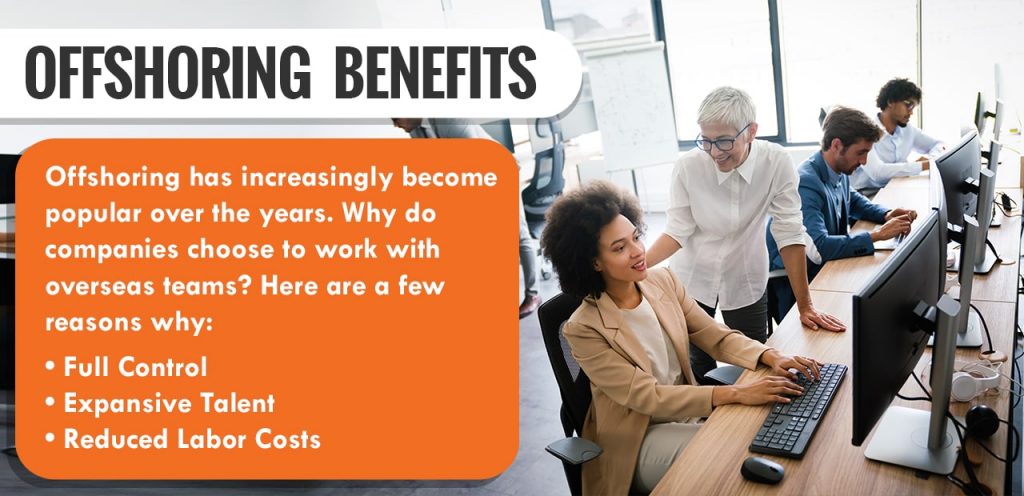
Offshoring has increasingly become popular over the years. Why do companies choose to work with overseas teams? Here are a few reasons why:
- Full Control. Offshoring leaves you full control over employment management and business operations. You get to call the shots over how a task is done, when people report for work, and standard work procedures.
- Expansive Talent. You get higher possibilities of recruiting qualified and talented people if you expand your network to other locations. India, for instance, is rife with engineering and IT specialists if you need web development and technical support. The Philippines has a high English proficiency should you need a team to manage your customer support and content development.
- Reduced Labor Costs. Cost-cutting is no doubt the primary reason that many companies offshore. With lower real estate, labor fees, and cost of living in other countries, businesses are able to maximize their capital, while still affording top-notch talent.
 Drawbacks
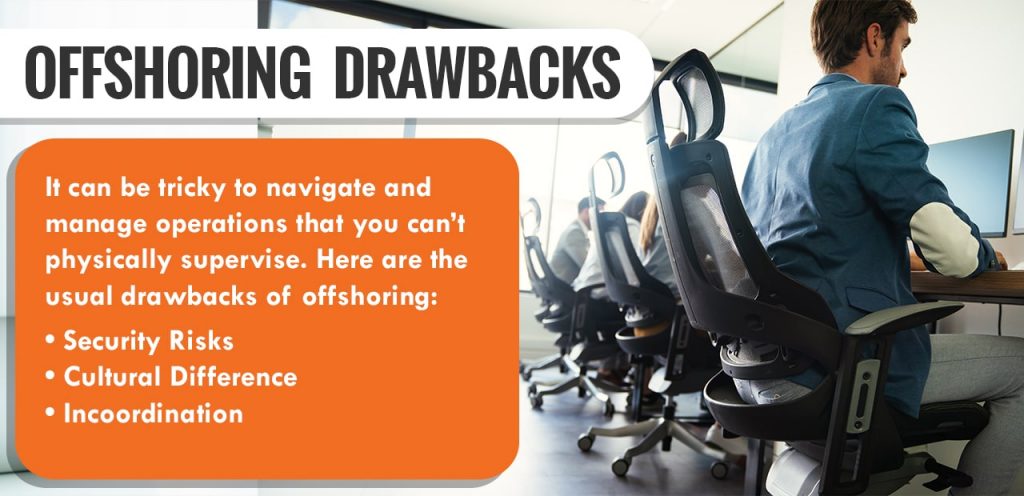
It can be tricky to navigate and manage operations that you can’t physically supervise. Here are the usual drawbacks of offshoring:
- Security Risks. Protecting your intellectual property will be more difficult when working with offshore teams. Some countries may have different or lesser IP rights and regulations. This can result in loopholes that may put a company’s intellectual property at risk.
- Cultural Difference. Cultural differences can play a major role in the dynamics of your team. Expect contrasting ways of doing tasks, communication challenges, and different ways of approaching conflict or issues when working with offshore teams. That is why overseas teams usually go through cultural and communications training from the get-go. This will help bridge cultural gaps, especially if you’ll have your team working directly with your customers.
- Incoordination. Working with people in different time zones can be complicated. Unlike outsourcing that can come with a full-service agency, you’re responsible to recruit, train, and manage your employees. Businesses should expect possible collaboration issues and even delays in meeting timelines.
Final Thoughts
Do you need help accomplishing short-term or seasonal projects? Don’t have the budget or proper workload to require a full office and operations? Outsourcing will ease the day-to-day operations of your business while growing your brand.
Need to expand your network while retaining full-scale control over your employees? Offshoring will help you reduce business costs, so you can optimize your funds and stick to your own workflow and processes.
Knowing the key difference of outsourcing and offshoring as well as their respective purposes, benefits, and drawbacks will help you decide which arrangement will work best for your current needs and goals.
While the pandemic has halted and redirected businesses to unprecedented routes, it has highlighted the profound significance of remote working and collaboration.
Both outsourcing and offshoring have empowered economies while uniting people beyond cultural and geographical differences. From small and independent businesses to big, household brand names, thousands of products have been put to life in one way or another through both business models.
[activecampaign form=68][/vc_column_text][/vc_column][/vc_row] READ MORE