3 Proven Business Growth Strategies You Can Start Doing Today
[vc_row][vc_column][vc_column_text css=”.vc_custom_1625553666214{margin-bottom: 0px !important;}”] As the end of the year draws near, it’s typical for business owners to be more mindful of your company’s financial standing. How far have you gone since you set your goals earlier this year? What are your plans for the coming year or the one after that? It’s also around this time when speculating about ideas on how to increase business growth long term becomes a pressing issue. But what does business growth exactly mean for your business?
Business Growth: What does it mean for your business?
Contrary to what many believe, business growth isn’t linear. It doesn’t necessarily equate to a surge in revenue over time. Your brand can, in fact, go back and forth as a growing company, and there are several aspects where you can achieve growth. Below are the different manifestations of business growth:
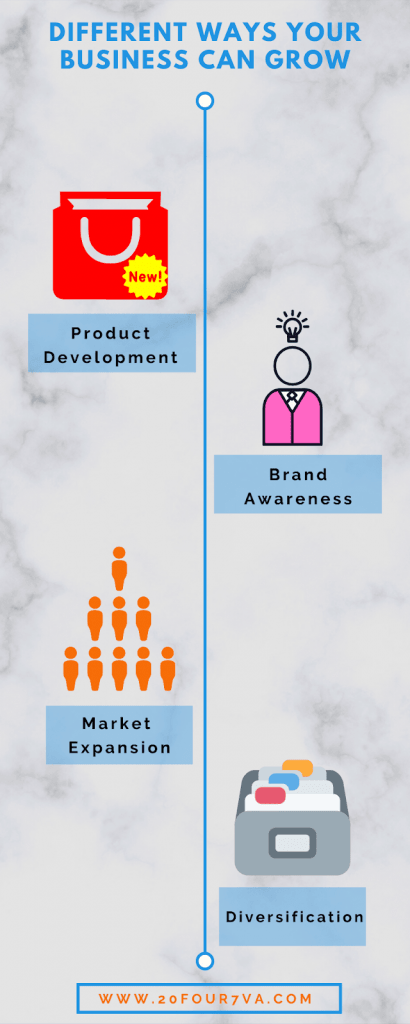
- Product development – this is when you create a new product or branch into a different product line that either supports your current one or answers a similar need. For example, if you make handmade soaps, you can create a version that is specifically targeted to people with sensitive skin.
- Brand awareness – you can still grow your business even without having to add a new product or service. When your brand awareness is boosted, many people get to know your brand and you have higher chances of winning over new customers.
- Market expansion – this type of growth happens when you penetrate a segment of a market or increase your user base. You can expand your prospects by adding a new product, bundling your current ones, and lowering your rates. Rebranding is also another way of expanding one’s market. For instance, when Redbull introduced its tropical flavors, it became more inclusive and earned more customers among women and younger people.
- Diversification – In business, this means growing your brand by joining entirely different markets. Diversification can either be as far out as dabbling in a new industry or as simple as targeting a different demographic for your current product. An example of the latter is when you drop a version for men of a product that was previously dedicated to women.
Because there are different types of business growth, there are also different ways to approach developing a growth strategy. The good news is that you don’t need to venture far and wide to push your company forward. Of course, some strategies need to be specific or unique to a certain form of business development. For example, you need to do a comprehensive market investigation and supply research if you’re planning to add a new product.
Driving new business development also means having strategies with repeat value that you can apply instantly. Such are these 3 proven business growth strategies that you can start doing today:
1. Listen to customers and adapt.
Apart from answering basic service inquiries or direct customer concerns, make it a point to check out how people rate your brand.
Entrepreneurs today have more access to customers, thanks to social media and Google. Through Tweets, mentions, and Google reviews, you can listen in to what people are saying about your products and services. Perhaps you can make your order process simpler and faster. Maybe you can shorten your response rate from 24 hours into 2-3 hours only. Often, customer feedback shows their pain points. By going out of your way to solve these issues, you make it easier for customers to choose you over others. More importantly, you encourage word-of-mouth recommendation, which remains as a strong form of promotion even today.
2. Save even for sunny days.
If you’re only saving for the rainy days, then you’re highly likely to splurge when business is going well. Being financially responsible takes discipline. And discipline is achieved by doing small, deliberate acts every day that support your goals and align with your vision.
Set aside a portion of your income for emergencies, retirement, and re-investment. What is left is only what you should spend for current needs or wants. Saving also means being budget-savvy in your business finances. Make sure you’re not doing any of these 4 budgeting practices that harm your business.
3. Get better with asking for help.
A good leader identifies the need for task delegation. As an entrepreneur, if you want to better manage your business, you need better ways of delegating responsibilities. In a similar vein, this means knowing where to seek quality help.
This is what makes virtual assistance an ideal fit for both startup and established brands. For one thing, it is an easier, more affordable employment arrangement. For another, you can delegate different tasks to someone or start building a team of virtual assistants without breaking the bank – or running risks with the IRS.
Here’s a short list of the different ways a virtual assistant can help your business:
- Creating content for your social media, blog, and email
- Answering customer inquiries and comments
- Processing orders and updating inventory
- Marketing
- Website development
- Bookkeeping
- Managing events and appointments
- Research
- Public relations
- Creating and editing videos
For small business owners and solopreneurs, working with a virtual assistant can initially feel daunting or excessive. Wouldn’t it be risky to work with someone you can’t personally meet and manage? Isn’t virtual assistance a luxury for established brands? If you feel the same way, know that:

- Working with a staffing agency such as 20four7VA makes the hiring process seamless and VA management easy and collaborative.
- Not working with a virtual assistant can be more costly. It’s easier to see the worth of this investment if you consider how these 4 solopreneur challenges are made manageable by working with a VA.
Growing your business need not be a complex set of rules. It can be simple tweaks in how you handle customer concerns or money no matter the season. It can be the simple knowledge of the things you can use a virtual assistant for, so you can find the right person fit for the job. Whichever way you envision your business to grow, you can get closer to your goal by doing these 3 growth strategies today.[/vc_column_text][/vc_column][/vc_row]
READ MORE
36 Tasks eCommerce Virtual Assistants Can Do
[vc_row][vc_column][vc_column_text css=”.vc_custom_1645032861674{margin-bottom: 0px !important;}”] There’s no better time to go into the eCommerce business than the present. With so many ways for aspiring online retailers to start their own company with a small capital, and with so many skilled eCommerce virtual assistants to help them out, it’s not surprising to see how many more online stores are cropping up in various marketplaces like Amazon, eBay, Jet, and Etsy. Many others are also creating their own online stores using easy-to-use and DIY-friendly tools like Shopify, BigCommerce, and Magento.
But while it’s easier now more than ever to start your own eCommerce business, the sheer number of competitors you’ll be facing means that keeping your store afloat and profitable is a lot more difficult. How do successful eCommerce business owners scale their businesses without being indebted due to massive labor costs? By hiring eCommerce VAs or teams of them to help out.
If you want to keep up with the stiff competition in the eCommerce industry, you have to provide exceptional customer service, ensure that your store has high-quality content and images, make sure that your store is ranking high on Google and other search engines, and so on and so forth. These are just a few of the things that hiring a virtual assistant for eCommerce store management can achieve.
What is an eCommerce Virtual Assistant?
An eCommerce virtual assistant is someone who is especially skilled in doing tasks related to eCommerce such as online store management, customer service specifically for online stores, content for product descriptions, and many more.
eCommerce virtual assistants can do tasks that administrative virtual assistants can do like email and phone support, database management, customer engagement, and so on. The main difference is that an eCommerce VA is actually trained to do all these things specifically for eCommerce businesses. They are either trained or experienced (or both) in doing eCommerce tasks, and they are adept at handling tools, apps, and software that are used in maintaining an eCommerce business.
Some eCommerce virtual assistants can also do tasks that specialist virtual assistants can do such as content writing, SEO, and graphic design. However, their skills in those areas are typically targeted for eCommerce purposes. For instance, an eCommerce VA can do content writing for product descriptions or social media marketing campaigns, but they may not be skilled enough to write blog articles or PR articles unlike specialist content writer VAs.
If you’re running an eCommerce business, it’s highly advisable to hire at least one eCommerce VA to ensure that someone in your virtual staff has knowledge and experience in dealing with common eCommerce tasks.
[activecampaign form=66]
Hire an eCommerce Virtual Assistant to Do These Tasks
If you’re still unclear about what you need to hire an eCommerce VA for, here’s a list of the most common tasks that an eCommerce virtual assistant can handle for you:
ACCOUNT MANAGEMENT
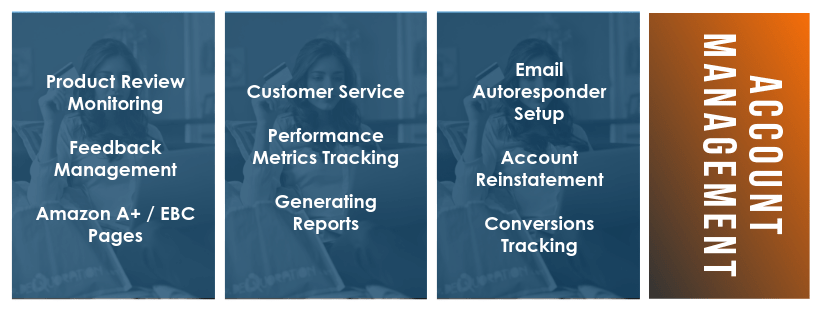
Managing your account on any marketplace can be very tedious. Marketplaces like Amazon and eBay impose very specific rules for stores, so it’s important to make sure that you’re following them all and ensuring that your store meets all standards to avoid getting penalized, or worse, shut down. How can an eCommerce VA help with account management?
- Product Review Monitoring – involves checking your product reviews constantly to ensure a high product rating and flagging fake reviews for removal. They may do this manually or use a review monitoring tool of your choice.
- Feedback Management – involves monitoring customer feedback and relaying them to the correct stakeholders to improve products and customer experience.
- Amazon A+ / EBC Pages – creating Amazon A+ content and Amazon Enhanced Brand Content which includes multimedia like videos, interactive widgets, and other visually rich content.
- Customer Service – helping customers with their orders, shipping, and other questions through chat, phone, or email.
- Performance Metrics Tracking – tracking important store and customer data such as customer retention, revenue, average order value, and more.
- Generating Reports – generating comprehensive but easy-to-read reports from your performance metrics.
- Email Autoresponder Setup – setting up automated emails for typical customer transactions such as order placement, account signup, and more.
- Account Reinstatement – getting your Amazon, eBay, or other marketplace accounts reinstated in case of account suspension.
- Conversion Tracking – setting up and tracking conversions or sales on your online store or eCommerce website.
INVENTORY & ORDERS
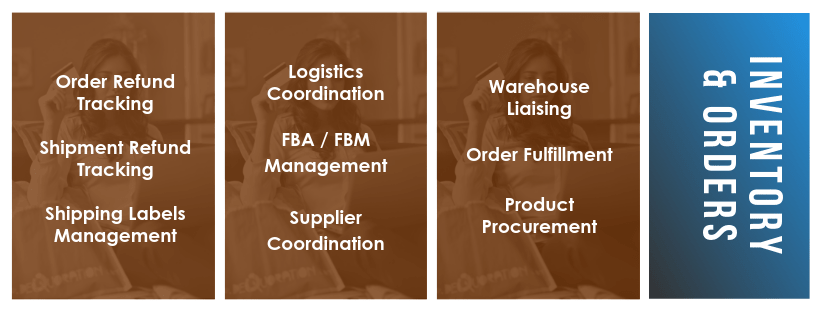
An eCommerce VA can also help you ensure that your store has the right amount of inventory and that all orders, returns, and refund requests are fulfilled correctly and in a timely manner. Here’s a more detailed look at what an eCommerce VA can do when it comes to inventory and order management.
- Order Refund Tracking – making sure that order refund requests are valid and that valid refund requests are fulfilled.
- Shipment Refund Tracking – ensuring that failed shipments are refunded accordingly.
- Shipping Labels Management – managing the creation, printing, reprinting, voiding, and more of shipping labels.
- Logistics Coordination – coordinating the movement of inventory, and when applicable, materials or equipment, between supplier, store, storage, and warehouses.
- FBA / FBM Management – managing and categorizing your Fulfillment by Amazon (FBA) and Fulfillment by Merchant (FBM) items.
- Supplier Coordination – coordinating with suppliers for materials or store inventory.
- Warehouse Liaising – coordinating with marketplace warehouses or store warehouses for storage of your inventory.
- Order Fulfillment – involves handling online fulfillment of orders such as liaising with third-party fulfillment providers and managing shipment.
- Product Procurement – involves selecting the best vendors and suppliers, arranging terms of payment and managing purchase requests.
LISTING MANAGEMENT

High-quality listings are listings that convert. However, it can be difficult to ensure that all your listings have great photos, content, and other enhancements if you’re doing everything yourself. This is one more thing that an eCommerce VA is good for. Here’s how eCommerce VAs can assist you with listing management.
- Multi-Variation Listings – ensuring that your listings have the correct attributes for a smoother customer experience during product selection and checkout.
- Listing Optimization – optimizing your listings including SEO-enhanced content, product photo editing, and more.
- Flat File Product Listings – generating accurate flat files of product for faster bulk editing of product listings.
- Product Title / Description – creating product titles and descriptions that are informative and catchy enough to entice customers to purchase your products.
- Product Listing Monitoring – monitoring important and potentially harmful product listing issues to avoid blocked and inactive listings.
- Product Price Monitoring – extract or monitor data from competitors to ensure that your product prices remain highly competitive but profitable.
- Listing Enhancements – improving listing content, images, and other variables for better ranking and marketability.
- Keyword Research – researching the right keywords to target (what potential customers search for) to improve product descriptions.
- Product Image Editing – basic image editing for more attractive product listings.
INTERNET RESEARCH
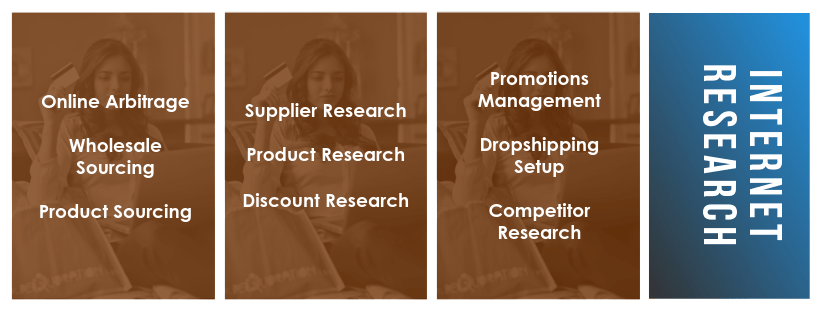
Keeping up with your competitors and industry trends requires lots and lots of research. Free yourself from hours of conducting research yourself by hiring an eCommerce VA to do internet research instead. Here’s what they can help you with when it comes to online research.
- Online Arbitrage – researching items in various marketplaces and purchasing products or creating a database of products with high profitability.
- Wholesale Sourcing – researching wholesalers who can provide high-quality but profitable products to add to your inventory or replace existing products.
- Product Sourcing – looking for trending products to improve your store offerings.
- Supplier Research – researching reputable suppliers who can give a good price for quality products.
- Product Research – conducting online product research for your product development team or to improve product marketability.
- Discount Research – researching promo and discount ideas for marketing.
- Promotions Management – managing your promotions to ensure a high ROI.
- Dropshipping Setup – finding reliable dropshipping suppliers and setting up dropshipping processes to ensure smooth transactions.
- Competitor Research – researching competitor products, promotions, marketing strategies, and pricing and generating reports based on gathered data.
One thing to take note of is that not all eCommerce VAs can do all of the tasks above. To build an effective eCommerce virtual assistant team, you need to hire eCommerce VAs with different sets of skills to complement each other’s skill strengths and weaknesses.
Do You Need an eCommerce VA?
Many eCommerce business owners, especially those who are just starting up, think that they only need to hire an eCommerce VA once their store has really started taking off. This is a common misconception. There’s no waiting time needed to get help when setting up your online store.
Whether you’re just starting your online store or are already running one for a couple of years, hiring an eCommerce VA is always a worthy investment. Even just one eCommerce VA can help you launch your online store more successfully and actually speed up the process of launching. The faster you launch your store with high-quality product listings, the faster you recoup your capital. Also, it’s pretty important that your first few customers get the best possible customer experience and support, and an eCommerce VA can definitely help you ensure that.
If you’ve been in the eCommerce industry for a few years, and you think that you’ve got everything covered, think again. There are so many improvements that can happen to your store when you hire an eCommerce VA. The best part is that outsourcing tasks to an eCommerce VA, especially overseas VAs, doesn’t require a massive budget. You can pay only for the hours you need or hire them only for seasonal support. It’s definitely easier to scale your eCommerce business if you don’t hire full-time local workers for every single thing.
Ready to build your team of exceptional eCommerce virtual assistants? Let us help! Submit a consultation call request (it’s totally free) to know what kind of eCommerce virtual assistant your business needs now.
[activecampaign form=66][/vc_column_text][/vc_column][/vc_row] READ MORE3 Manageable Ways to Cut Business Costs

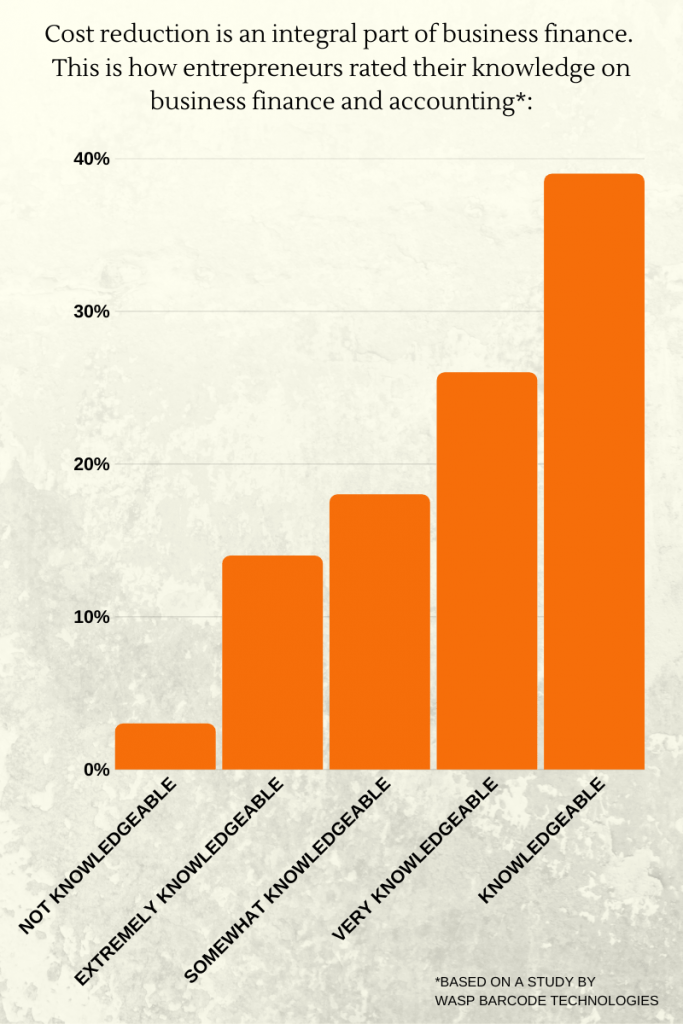
The surest way to increase business profit in the long run is to reduce business costs. While the logic behind this idea is easy enough to understand, the process of cost reduction isn’t as straightforward. Perhaps this is why many entrepreneurs don’t know how to control expenses in a company. In fact, a study by Wasp Barcode Tech revealed that only 14% of entrepreneurs are confident about their knowledge on business finance.
Learning to Navigate the Tricky Business of Cost-Cutting
When you search for tips on how to reduce operating expenses in business, you’ll find that most cost saving strategies are drastic or complicated. This is probably because these sources contain cost cutting ideas for large companies, rather than small businesses.
Apart from being hard to follow, these tactics can have negative repercussions for your business. The good news is that strategies on how to cut costs don’t have to be too elaborate. In fact, the more straightforward and convenient your approach is, the easier it is to stay committed.
Here are 3 manageable ways to cut business costs:
1. Arrange work-from-home schedules.
According to Global Workplace Analytics, 50% of the workforce consists of jobs that can be done at home and up to 90% of employees want the option to do so. The same study revealed that only 25% enjoy this arrangement.
Remember that office real estate takes a huge chunk of one’s business expenses. Whether you rent or own your working space, you also need to account for utilities, furniture, and supplies. Think about how big of a difference it would make if your team has work-from-home days!
Apart from the savings you can make in office space expenses and utilities, you can also expect higher productivity among employees when you let them work remotely. When telecommuting is an option, employee morale and job satisfaction increase among workers.
2. Take better care of current customers.
Many entrepreneurs concentrate their marketing efforts on new customers. However, campaigns towards new customers can be costly. Remember, you are promoting your product or service to an audience that probably don’t know you yet. If you want to save costs, funnel a good portion of your marketing funds towards existing customers instead.
A study by Annex Cloud revealed that long-time customers are highly likely to spend more and recommend a brand to others. So, rather than cooking up gimmicks to attract new people, concentrate on how to make your current shoppers happier. Prioritize them for freebies and discounts and offer exclusive perks to high spenders.
3. Outsource specialized and non-core tasks.
Hiring more people as your business grows is inevitable. However, paying for substandard work output or non-core staff shouldn’t be.
Outsource admin chores and specialized tasks such as marketing and bookkeeping. When you do, you still get the job done without having to spend as much time and money as you would in traditional employment.
Virtual staffing is also the most feasible way to expand your team without having to expand your office space or blow up your utility bills. As a business owner, especially for small business owners, it’s a good idea to outsource tasks to a virtual staff because it’s an easy and effective answer to the question of how to reduce expenses in office.
Just like other aspects of running a business, cost reduction must be done with patience, commitment, and skill. To take care of the latter, follow these 3 manageable ways to cut business costs.
READ MORE4 Ways to Increase Business Growth by Outsourcing Marketing

Outsourcing has proven to be an excellent way to increase productivity within a company. However, according to a study by Clutch, only one-third of small companies in America outsource at least a single business process. A separate study has shown that of the business processes being outsourced, outsourcing marketing tends to be least priority.
Are your misgivings toward outsourcing marketing services preventing you from driving new business development? It may be time to reconsider the difference outsourcing your marketing can make for your business.
4 Signs You Need to Outsource Your Marketing Efforts
Just because some businesses outsource their marketing efforts doesn’t mean that you should, too. Right? This is the kind of thinking that keeps some entrepreneurs from reaping the benefits of outsourcing marketing. While it’s logical to be cautious whenever you’re making businesses decisions, it pays to check if it’s worth it to let experts handle marketing for you.
Here are 4 signs that reveal your need of marketing assistance:
- Your paid ads aren’t pulling results. Ads from Google, Bing, and social media channels have user-friendly interfaces. Still, sticking to the usual features and suggestions from each channel is not enough to generate an effective performance.
- Your content isn’t professionally written. From product descriptions to blog and email content, writing for business must both be strategic and engaging. Otherwise, people will just skip over or forget your posts.
- Your day-to-day tasks overshadow your long-term goals. Does ticking off routine tasks take precedence over your long-term goals? Don’t push back your goals to scale or expand just because you’re too busy with low-impact tasks.
- You or your staff are overworked. Are you or an employee simultaneously handling different branches of business? Excessive multitasking has never yielded quality output, especially in business.
If you’ve experienced these situations, it’s time to work with a marketing virtual assistant. What makes outsourcing an ideal arrangement is its affordability and convenience compared to traditional modes of employment. Virtual assistants get paid by the hour or per project, so it’s a great fit for businesses with limited funds and seasonal needs.
Below are 4 ways to increase business growth by outsourcing marketing.
 1. You get a better-performing marketing strategy.
People who dabble in marketing without much experience tend to focus on the what instead of the why. What are the hottest trends in social media today? What keywords can get you higher ranking in search engines? What tools can you use for free? While these are all valid questions to consider, they’re not enough if you’re in it for the long haul.
According to Gleanster Research, 34% of companies don’t think their current marketing approach is enough to see them through the coming years. If you want your efforts to scale and take you places, you also need to consider the why of things. Knowing why you do what you do helps you weed out bad investments. It pushes you closer to your long-term goals, rather than being sidetracked by transient concerns.
Outsourcing internet marketing to a virtual marketing assistant allows you to progress from researching tactics to formulating an actual strategy. As a field expert, a marketing VA can see beyond your short-term targets and limitations. Leverage their expertise and create strategies that can grow your brand.

2. You get a clearer picture of your standing.
Marketing tools and platforms often come with an analytics dashboard. Even blogs and social channels you use for business generate analytics reports. However, no matter how user-friendly or comprehensive these reports are, they’re useless without an expert’s eye.
How many visitors clicked through your ads to visit your website? How long did they stay? What are people reading on your blog? What posts do they share? Collecting this data is easy; figuring out what to do with these numbers is another matter. A marketing expert can tell you what to do with these stats. They can help you determine which campaigns you need to continue or stop. They would also help you make the most of an ad that has garnered high results.

3. You choose tried-and-tested processes.
The internet is teeming with tools for businesses. There are apps for design, resources for productivity, and time-saving apps for marketers. Figuring out what processes work best for you while trying to capture high-quality leads can be overwhelming for one entrepreneur to handle. You will do yourself a favor when you let the experts handle it instead.
Marketing VAs have a cornucopia of tried-and-tested tools for different functions. They know which apps can make their job easier and what processes yield the best results. Instead of spending your time and effort figuring out marketing processes, you can focus on putting together campaigns and building relationships with customers.

4. You save a LOT without sacrificing output.
Hiring talented, experienced staff can be expensive. Many companies would instead hire non-experts and train them for specific marketing tasks and campaigns. However, marketing is dynamic and expansive. A few years ago, brands only work on website content and email marketing. Now, social media marketing is a critical part of the equation.
You need experts in SEO, content, social media, and email to move your brand forward. By outsourcing social media marketing or outsourcing content marketing or any other aspect of digital marketing, you take care of these business facets without breaking the bank. You’re also relieved from providing office space and supplies as well as allocating funds for salary, benefits, and insurance. Because the hiring groundwork and management of VAs are handled by their staffing company, you save a lot of time and money without putting work quality on the line.
As a specialized field, marketing is too important and complex a branch of business to be delegated to just anyone. Partner with a digital marketing virtual assistant to get returns for your efforts and move your brand forward.
Looking for outsourcing marketing companies? We can help. Schedule a free consultation call with us today and let’s work together to build up your business.
READ MORESocial Media Marketing: 3 Tips to Get Ahead

An effective social media marketing strategy gives small businesses so many opportunities for finding customers. Just check out these excellent social media marketing stories.
A mother working on a shoe-string budget wanted her children to have healthy meals at school, so she put together nutritious lunch boxes and shared photos of them on Facebook. Eventually, her budget-friendly lunch boxes attracted thousands of followers and prompted her to become a solopreneur.
This is the story of Easy Lunch Boxes, an idea that has evolved into a company selling lunch containers as well as virtual and print materials for meal preparation.
Established companies can also use social media for re-branding or connecting to a different audience, such as in the case of Red Bull:
Although the energy drink brand has been around for decades, Red Bull sought to further expand its market by introducing new flavors. In one campaign, the company aimed to promote its tropical or Summer Edition drink. The brand started posting summer-themed video content and photos using the #thissummer hashtag on social media.
Their campaign reached more than a million people. More importantly, the company saw a 7-point decrease in the unconvinced market. They succeeded in their aim to shed their predictability and have people see Red Bull in a brand new light through its new flavor.
This is the power of social media marketing: it can help a business find and connect with the right people, no matter how young or old they are in the industry. That’s why it’s no surprise that businesses of all shapes and sizes have flocked to Facebook, Twitter, Instagram, and Pinterest!
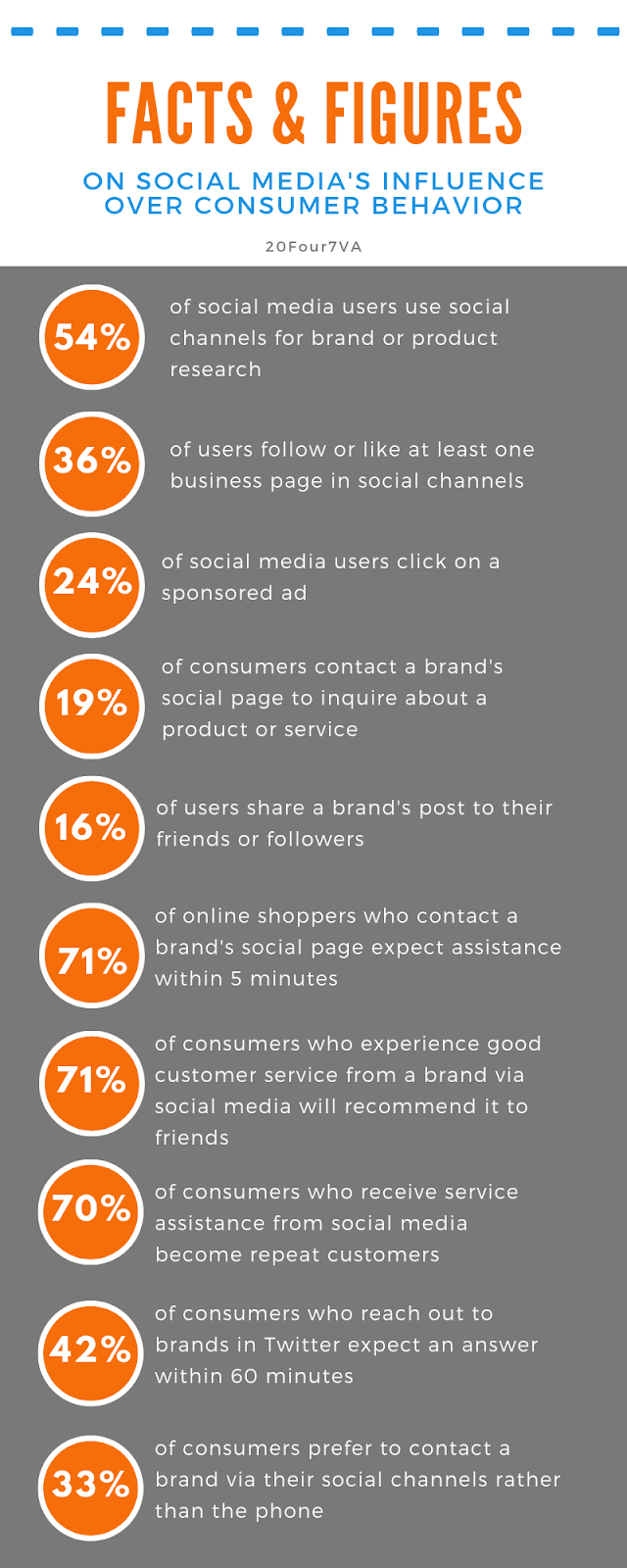
These findings from the Global Web Index illustrate how much social media platforms have influenced everyday life:
- 54% of social media users search channels like Facebook and Twitter for product or brand research
- 36% followed or liked a brand on social websites
- 24% clicked on a sponsored ad
- 19% used a brand’s social channels for inquiry
- 16% shared a brand’s post to their friends or followers
A separate study from Ambassador took a closer look at social media for business and revealed the following:
- 71% of online shoppers expect practically real-time assistance from a brand’s social channels (within 5 minutes of contact)
- 71% of consumers who experienced good customer service from a brand’s social channels are more likely to recommend it to others
- 70% of people who received service assistance through social media became repeat customers
- 42% of consumers who reached out to brands in Twitter expect an answer within 60 minutes of contact
- 33% of consumers prefer to contact a brand via social platforms than phone
With so much on the line, you can’t just follow any social media marketing guide that you encounter. So how can you leverage these channels to attract and engage with your target audience?
Here are some of the best social media management tips to help you out:
1. Create a clear buyer persona.
A buyer or customer persona represents the key characteristics shared by people who belong to your target market. Instead of observing random audience behavior, creating a buyer persona will help you collect emotive information. That means identifying customer demographics as well as the intricate details that make customers tick.
Who are you selling to or trying to connect with? What type of content will resonate more with your target market? When you have a well-defined buyer persona, you have clear, precise answers to these questions.
Use these questions to help you sharply outline your buyer persona:
- How old are they?
- Where do they live?
- What is their gender?
- What is their marital status?
- What is their education level?
- If they are working, what is their industry and job level?
- What is their typical day like?
- What do they do for fun and how much time do they spend in it?
- What kind of websites do they frequent and for what reason?
- What makes them angry, happy, or stressed?
- What do they worry about?
- What are they proud of?
- What do they hope to achieve?
- What can make or ruin their day?
- Where do they prefer to shop?
- How do they prefer to contact a brand?
- How do they define a good deal?
A thoroughly researched customer persona helps you with creating content and experiences that people will remember. It helps you find the most appropriate social channels to use and the best ways to use them. Having one will also help you create products and services that give people a bang for their buck while adding value to their life.
2. Know your social media priority.
Now that you’ve identified your ideal buyer persona, you’re equipped to move on to the next step: knowing your social media priority.
Equally sharing content and resources across all platforms seems to be a good idea, but it’s not always a feasible one. For one thing, it can be costly and time-consuming. For another, social channels have different algorithms and strengths. What works for one might not have the same impact on another.
So when you’re creating a social media marketing plan, remember to determine your social media priority. To help you with this task, here are some statistics about each platform:
Facebook:
- Has 2.32 billion active monthly users as of 2019, making it the next most popular website after Google
- Majority of US users are between the ages of 25-34 years old
- Users aged 65 and above have doubled up since 2012; Teenage Facebook users declined from 71% (2014) to 51% (2018)
- Facebook contact boosted brand confidence for 66% of consumers
Twitter:
- Has 321 million active monthly users as of 2019
- 40% of Americans between the ages of 18-29 years old use Twitter
- 46% of users visit Twitter every day, with 26% frequenting the platform several times a day
- Tweets with attached videos have 10 times higher engagement and are 6 times more likely to be shared
Instagram:
- Has 1 billion active monthly users as of 2019
- About half of Instagram users are between the ages of 18-34 years old
- 80% of Instagram users follow at least one brand on Instagram
- 60% of users admit to discovering a brand through Instagram
- 72% of teenagers in America are Instagram users
Pinterest:
- Has over 250 million monthly active users as of 2019
- 34% of Americans between the ages of 18-49 years old use Pinterest
- 81% of Pinterest users are women
- 83% of Pinterest users made purchase decisions based on brand Pins
- 77% of users discovered a brand through Pinterest
- 66% of users source Pinterest for finding last-minute gift ideas
If your target consumers are women, you might want to funnel your resources on Pinterest. If your services are for millennials, Instagram is the best place to put in your investment. Different people use social channels in varying levels of frequency and purpose. You need to know which channels would best help you reach your customers.
3. Be better at telling a story.
“Content is king” is probably one of the oldest phrases in online business marketing – and for good reason. With so many brands to choose from, people are just wired to respond more to campaigns with emotive content. The only way to grab someone’s attention is to evoke a reaction.
The problem is, while brands still consider content important, they fail to recognize that the medium and ways for sharing said content have changed. According to content marketing expert Gary Vaynerchuk, so many companies today follow the same content strategy they did 10 years ago. Why?
Apart from character limits, social media – with its endless pit of information – just tend to curb people’s interest and concentration. So, how can you tell a story with a 140-character limit? How can you bolster your place in someone’s mind in only 6 or 60 seconds?
Take a leaf out of the Gary Vaynerchuk social media marketing book. Use this inverted pyramid for content curation:

- Document main content. Put together long-form pieces of content like blog articles, vlogs, podcasts, or webinars. Use it to document your entrepreneurial journey, outline your vision, or to tell people about your wins, losses, and ambitions.
- Re-purpose main content into micro pieces. Create quotes, Tweets, memes, GIFs, or Instagram stories derived from your main content.
- Distribute in social media. Here are 5 tools to help you share social media content.
TIP: Planning your social media content is one thing, producing it is another. Hire a content writer VA to help you put your content together. Content writers know how to strike a balance between engaging and informative – an essential recipe in social media posting.
For modern-day businesses, social media go beyond raising brand awareness. Instead, they have become the channels that people prefer for interaction, the platform of choice for quick brand research, and the yardstick that people use to gauge brand credibility. These social media tips should help you get ahead of the game.
Recommended reading: 60 Tasks You Can Outsource to a Virtual Assistant Team to Grow Your Business
READ MORE