Search for Google Analytics Alternatives: Top 3 Web Analytics Tools You (Probably) Haven’t Tried Yet

Google Analytics (GA) is almost indispensable in business today. It’s a must-have tool not only for improving one’s website ranking in Google but also for fine-tuning marketing plans.
However, going premium with GA to unlock all of its features can be costly. At $150,000 annually, it’s really not the best option for small businesses. Fortunately, startup entrepreneurs working to get in-depth web and customer behavior analyses have other more affordable options. There are many Google Analytics alternatives in the market today that can provide you with comprehensive data without the same steep price.
Have a look at the top 3 web analytics tools that you can use in place of Google Analytics Premium:
-
FoxMetrics
FoxMetrics prides itself on being a convenient and swift platform for harnessing and delivering customer-level data.
Key features:
- Easy Setup – simply copy and paste the FoxMetrics script to run the program.
- Customer Behavior Monitoring and Segmentation – build profiles of your customers and would-be buyers by tracking site activities. You can then segment the profiles according to your preferred categories, so you can create and send targeted campaigns.
- Report Creation and Analysis – create customized reports or make use of built-in ones. Either way, generating reports will help you improve your website and personalize the shopping experience of your customers.
Pricing: The FoxMetrics Standard plan starts at $99/month or $828/year if paid yearly. It covers 1 website, 12 months of data retention, and 10,000 impressions. Professional, Agencies, and Enterprise plans are also available at a higher cost.
-
Clicky
Users of Clicky claims to give more comprehensive support than Google Analytics. Supporting 1,152,424 websites under its wing, Clicky boasts of delivering web analytics in real time.
Key features:
- Detailed Reports – Traffic source links, number of visitors, visitor activities, average time spent on site, bounce rate – these are just some of the details Clicky users can find in a report.
- Real-time Results – Clicky prides itself in producing up-to-the-minute data.
- Spam and Bot Blocking – Clicky has inclusive bot and spam detection and blocking systems, so you know your site visitors are 100% authentic.
Pricing: Entrepreneurs can choose between plans with prices ranging from $9.99 to $99.99.
-
MixPanel
MixPanel is an analytics platform that helps entrepreneurs create the best user experience through deep user understanding and corresponding action plans.
Key features:
- Customer Engagement and Retention – Know what people are doing on your web pages and bookmark reports for ease of use.
- Insightful and User-friendly Reports – MixPanel combs through your data so you get only the most useful and insightful ones. It also generates easy to understand reports that can be conveniently shared and worked on by a virtual staff.
- Intelligent Action Plans – From push-notifications setup to telecommunications and customer support systems, MixPanel helps you design the best solutions based on its generated reports.
Pricing: Small businesses can enjoy limited features of MixPanel free of charge. This covers 5 projects, 2-months worth of data history, and 3 members per project. Startup and Enterprise plan pricing are available upon request.
Google Analytics is useful, but don’t limit yourself there. That doesn’t mean you have to spend a huge amount on GA Premium either. Boost your website ranking, design better experiences for your customers, and improve your brand presence online with these top 3 Google Analytics alternatives.
READ MORE
How to Become a Virtual Assistant While Still Working a Full-Time Office Job

For many office workers, having a side hustle is not so unheard of. With so many bills to pay and other expenses to cover, it’s difficult to save up when you’re just relying on one source of income. Maybe you have been wanting to transition into a home-based job as a virtual assistant, but you can’t let go of your steady source of income just yet. Whatever your reason for wanting to become a virtual assistant while having a regular 9-5 job is, it’s a given that your road to becoming a successful VA will certainly be challenging.
What You Need to Know About Virtual Assistance
Before spending a lot of time and effort into looking for virtual assistant jobs, you need to be 100% knowledgeable about the industry first. It’s important to know what you’re up against and to understand all the challenges you’ll be facing before deciding if you want to push forward.
Working remotely doesn’t simply mean using your current hard skills for a new job. Working in the office and working in the comfort of your own home is a lot different. For one, your home is probably not all that conducive to helping you focus on your work. Unless you live alone, you’ll be subjected to constant distractions and interruptions from your housemates and family members. Even if you live alone, you still have to be strong-willed enough to resist the temptation of watching TV, playing games, or even sleeping on the job.
You’re conditioned to think that your house is where you should be resting, relaxing, and generally enjoying yourself. If you want to succeed as a VA, even just as a side hustle, you need to be able to truly focus while you’re at home.
Being a VA also requires independence and responsibility. Since you’ll mostly be working by yourself, you need to be able to act as your own supervisor. You should be able to manage your time wisely and stay on track of your tasks and schedule. Too tired from your 9-5 job? Doesn’t matter, you still need to finish your daily tasks for your client. It takes a certain degree of self-sufficiency and responsibility to even just show up to your VA side job as needed and without making up excuses along the way.
Finally, being a VA often means that your clients will regularly challenge you into doing tasks outside your skillset; it’s just the nature of the job. Most, if not all, VAs are expected to do more than just a certain set of predefined tasks. You have to be resourceful and curious, and you definitely need to learn things and acquire new skills at lightning speed if you want to succeed in the industry.
Your Guide to Becoming a VA While Working a 9-5 Job
Now that you have had a glimpse of the common challenges of working as a VA, do you think you’re ready to embark on a journey towards building a career providing virtual assistant services? If you have been pondering the phrase ’how to grow my virtual assistant business’ lately, here’s a handy guide on how to start and grow your very own virtual assistant business.
-
Arrange your schedule.

The first thing that you need to do if you want to start a virtual assistant business is to make time for your new job. You need to have a solid schedule that you can stick to and not feel like you’re drowning yourself in work. Identify any time-wasters and try to eliminate them from your schedule. Of course, it’s still necessary to leave some time for rest, relaxation, and leisure.
-
Discuss your decision with the important people in your life.

Taking on a part-time job, whether remote or not, will require you to spend more time working and less time with your loved ones. Your decision also affects them, so it’s important to ensure that they understand the consequences and are happy to support you with your choice. Also, be prepared to say goodbye to your social life for a while, at least while you’re settling in and getting the hang of things.
-
List down all your skill sets.

Make an accounting of all your skills and specializations before trying to find jobs or clients. This is important when it comes to targeting the right venues for scoping out potential clients and easily sorting through job descriptions. It will also help you build a strong resume and portfolio that will attract the best clients.
-
Expect a lower rate than you’re used to.

Even though you already have years of experience in a particular field, it won’t directly translate to your experience in the virtual assistance industry. Be prepared to command a lower rate when you’re just starting out. Putting too high a price on your services will not endear you to many clients especially when they see that you don’t have much experience working as a VA yet.
-
Find your niche.

Once you have identified all your skill sets, you need to pick just one or two to specialize in. You want to build a reputation as an expert in that field so that you can command higher prices for future jobs and clients. If you’re still not sure what type of virtual assistant you want to be, here’s an article with a list of virtual assistant niches that might be of help to you.
-
Set up a home office you’d love to work in.

This step is essential to any home-based job. Our homes are not typically conducive to working, so you will have to make some changes to create an atmosphere that will help you concentrate and be productive. The first thing you need to do is to get a nice desk and chair to set up your workstation and get a computer that can handle everything you need to do for the job.
Once you have the basic equipment needed for your home office, you will need to look for a prime location to set it up. Look for a secluded spot with good lighting, minimal noise, and good ventilation.
-
Create a digital portfolio.

Gather your best works and compile them into a document or set up an online portfolio. This way, it would be easier to show your work to various clients, since you don’t have to look for samples of your work every time a potential client asks you for some.
-
Be visible to potential clients.

Although you want to keep your personal social media profiles private, you also want to have a professional account that’s visible to your potential clients. LinkedIn is the best place to do this. If you’re a graphic designer, you might also want to create an account on Instagram or some other image-based social media platforms that will serve as a quick, free, and easy to manage online portfolio.
-
Be selective about the job/s you’re taking.

Take advantage of the fact that you still have a regular source of income and be selective about potential jobs first. If possible, find one that offers flexible hours so that it will be easier for you to adjust your schedule.
-
Get assistance from a trusted virtual staffing company.

If you’re not confident about finding your clients by yourself or doing all the prep work, you have an option to apply at a virtual staffing company. Excellent virtual staffing companies can provide you with the basic information you need to start your VA career. They also handle HR and accounting duties, and they can give you great client or job choices easily. Some even provide free training to help you improve and prepare you for your future jobs and clients.
Becoming a Full-Time VA
Once you’ve gotten the hang of working as a virtual assistant and you find that you’re enjoying it, you will probably start considering doing it full time.
Before you completely transition into full-time home-based work, you need to do an assessment of your situation again. Working as a VA for 10 to 20 hours a week is also a lot different from doing it full time. For one, are you ready to stay at home for days on end? While some VAs work at coffee shops or co-working spaces from time to time, it’s usually more practical to stay at home. If you’re used to talking with several people or meeting people every day, it can be a major adjustment.
Another thing to prepare for when you become a full-time VA is the loss of your benefits and the manual filing of your taxes. There’s a lot of administrative work involved in becoming a VA, and you need to be responsible enough to handle all these.
If you want to make the transition a lot easier, it’s advisable to seek help from a trusted virtual staffing company. Companies like 20Four7VA not only help virtual assistants get the best clients, they can also help manage the background stuff such as HR, accounting, and training.
Ready to embark on your virtual assistant journey? Send us your application here.
READ MOREDo You Need Virtual Assistants for Your Small Business?
[vc_row][vc_column][vc_column_text css=”.vc_custom_1629271439761{margin-bottom: 0px !important;}”]
The virtual assistant industry is booming. With more and more entrepreneurs claiming that outsourcing tasks or hiring virtual assistants as one of the main reasons for their businesses’ rapid growth and continuing success, more and more business owners are beginning to see the benefits of hiring a virtual assistant or two to help scale their business.
Yes, virtual assistance is taking over the business world by storm, but are they a viable option for smaller businesses? After all, small businesses have a much more limited budget. In most cases, small business owners tend to do as many tasks themselves as possible because hiring even one more employee can have a major impact on their finances.
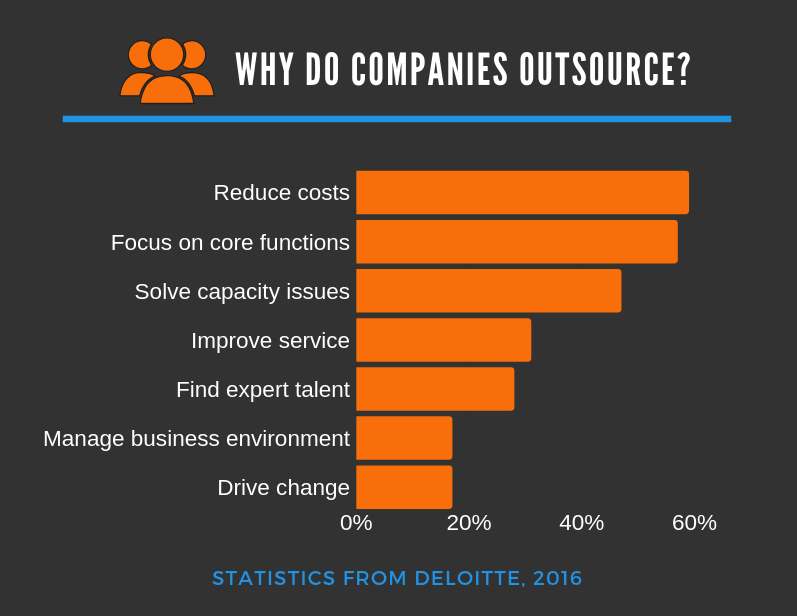
According to a recent survey by Deloitte, here are the top reasons why companies outsource:
- 59% – Reduce or control costs
- 57% – Focus on core functions
- 47% – Solve capacity issues
- 31% – Improve service
- 28% – Gain access to expert talent and knowledge
- 17% – Manage the business environment
- 17% – Accelerate organizational transformation
What does this mean? For one, it means that instead of bringing about more financial issues, hiring virtual assistant services can actually help resolve your budget concerns. Since reducing or controlling costs is the main reason for outsourcing, it goes to show that relying on a virtual assistant for small business tasks is actually a great way to save money as you scale your business.
Need more reasons to hire a virtual assistant or a virtual staffing team for your small business? Here are some good ones.
[activecampaign form=68]
Reasons Why Virtual Assistants are Perfect for Small Businesses
As seen in the survey mentioned above, business owners have many different reasons for getting virtual help. Here are some arguments that could convince you how hiring a virtual assistant can help you scale your small business and run it more efficiently.
- Virtual assistants can take any unwanted or boring tasks off your hands.
Admit it, no matter how much you love your company, there are many necessary but annoying or repetitive tasks that you would rather NOT do. You can easily hire a VA to assign these tasks so that you can spend more time doing what you truly enjoy!
- Virtual assistants can save you time and help you focus.
Hiring a VA who specializes in a particular task usually means that they can get the job done faster than you can. This not only helps you save time and money, but it also gives you more time to focus on things that only you can do such as dealing with high-level decision making or improving your business.
- Virtual assistants can help you brainstorm.
Having a virtual team can help you brainstorm because it’s easier to think of ideas when you’re bouncing them off someone else. Plus, your virtual team doesn’t just serve as a sounding board, they can also offer amazing ideas of their own!
- Virtual assistants can help you scale your businesses without hiring full-time staff.
There are many tasks you need to hire help for, but for small business owners, it’s not practical to have a full-time worker for each position. When you hire a virtual team, you can have someone work 40 hours on customer service while someone just works 20 hours for administrative tasks or 10 hours for social media tasks. This can help you allocate your funds more wisely and keep your workforce more flexible.
- Virtual assistants are great for seasonal work.
For some businesses, especially retail stores, there are seasons where there’s so much work to be done while other months are pretty quiet. Hiring virtual staff during peak seasons and offloading them during the quieter months can help you save a lot on labor costs.
- Virtual assistants from abroad cost much cheaper than local talent.
Choose a virtual assistant that comes from a country where the cost of living is cheaper. This means that virtual assistants there can offer you the same level of skill and experience at a lower hourly rate. It’s also important to hire a VA from a country where English is widely spoken or where English is a second language so that communication won’t be an issue.
- Virtual assistants can save you tons on infrastructure and other operational costs.
No more paying for office space, computers, and other common office supplies. There are plenty of expenses involved in running a traditional office, so going the virtual or remote route can help you escape from those costs.
- Virtual assistants can do some tasks more efficiently and produce better results than you can.
You might be an excellent CEO or business owner, but that doesn’t mean that you can do everything in your business better than anyone else. For instance, creating stunning graphics or a beautiful website is best left to expert graphic designers and developers. For quality content, a highly skilled and experienced content writer VA can probably do a better job. Leave these specialized tasks to the experts and focus on what you do best: growing your business.
Which Virtual Assistants Should You Hire?
When you’re just starting out a virtual assistant team, it can be difficult to figure out what position you need a VA most for or what are the most important skills to look for in your first VA. The best way to deal with this is to analyze your business processes and make a list of your priorities and needs.
Businesses of different types have different concerns, and these issues will be very important when you’re fleshing out your virtual staffing team. For instance, if you own an eCommerce business and providing better and faster customer service is your priority, a customer service VA who specializes in providing voice, email, or chat support might be the most important hire for you.
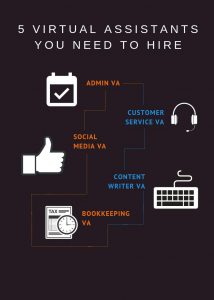
Here are some of the most common types of virtual assistants that you might need for your small business:
-
Administrative VA
Administrative virtual assistants can help you monitor and answer your emails, manage your calendar, organize your files, make travel arrangements, perform basic customer service duties, and do simple social media tasks.
-
Customer Service VA
A customer service virtual assistant specializes in providing fast responses to your clients’ or customers’ queries and comments. They make sure that your customers are highly satisfied with your service by answering questions and resolving complaints. Many businesses usually hire a customer service VA for each of the different communication channels they offer including phone, chat, or email.
-
Social Media VA
These days, having an engaging company or brand page on Facebook, Instagram, Twitter, and other popular social media platforms is a must. However, it can be difficult to manage them yourself while you run your business. You can hire a social media VA to create interesting posts, engage with your followers, schedule posts across all your channels, and generally keep your social media pages helpful and pleasing to the customers.
-
Content Writer VA
If you want a stellar online presence, then you have to have quality content. This goes for your website, your product descriptions, your company profile, your social media pages, your marketing campaigns, and so on and so forth. Good branding needs great content, so it’s helpful to hire an expert content writer VA to help you out.
-
Bookkeeping VA
Bookkeeping and accounting are two tasks that are very time-consuming, sometimes even mind-boggling, but absolutely essential to running a business. To make sure that your books are accurate and your finances are always in great shape.
Need more information about hiring a virtual assistant? This article has Everything You Need to Know When Hiring a Virtual Assistant.
Where and How to Hire a Virtual Assistant
When it comes to hiring a virtual assistant, you need to remember that not all VA hiring venues are created equal. There are certain pros and cons to hiring a VA you found on forums or social media compared to someone you can get from a legitimate virtual staffing company.
To help you decide which course is best for you, here’s a quick rundown of the pros and cons of DIY virtual assistant hiring versus hiring from a virtual assistant provide.
DIY Hiring
Pros:
- You can hire from job boards, forums, or social media platforms where you already have existing accounts.
- You set all the rules.
- You set whatever payment options and schedule you like.
Cons:
- You take care of the entire process: from hiring to training to payroll.
- You have to screen really carefully or you might end up with an unreliable, or worse untrustworthy VA.
- Your company’s privacy will be at a higher risk since freelancers don’t have to answer to a parent company.
Hiring from a Virtual Staffing Company
Pros:
- They take care of recruitment, HR, and payroll.
- Most virtual staffing companies pre-assess their VAs to help ensure reliability and skill.
- Most virtual staffing companies have fail-safe procedures in place in case your VA goes AWOL or does something detrimental to your company and privacy.
- Some companies also provide regular training or on-demand training for your VAs.
- Some companies like 20Four7VA offer free re-hiring in case your first VA hire doesn’t work out.
Cons:
- Most companies already have a set of rules for VA-client contracts.
- Pricing can be a bit higher because you’re paying for both the VA and the company.
If you decide that hiring a VA from a virtual staffing company is the right course of action, you can count on 20four7VA to help you get started. Just fill out this pre-consultation form, and we’ll guide you through everything you need to know about hiring a VA.
[activecampaign form=68][/vc_column_text][/vc_column][/vc_row] READ MORE5 Simple Ways to Lessen Business Operational Expenses
[vc_row][vc_column][vc_column_text css=”.vc_custom_1594882731103{margin-bottom: 0px !important;}”]
Keeping profits high and expenses low is essential for the survival and growth of any company. Many business owners prefer to overdo it on promotions and marketing to close more sales and gain more customers, that reducing expenses is often left at the back row. This is understandable since cost reduction doesn’t sound nearly as exciting as crafting online business marketing tactics that increase revenues and brand awareness. Besides, reducing expenses is often equated to cutting back – something that people don’t always associate with growth.
However, to keep your cash flow in check, you need to find ways to manage your operational costs more effectively. Otherwise, your new customers and increased sales would only cause your business to break even instead of profit.
What are Business Operational Expenses and How Can You Reduce Them?
Perhaps one of the reasons entrepreneurs don’t focus on lowering operational costs is because it usually means making huge sacrifices. Does that mean settling for a substandard brand when buying equipment? Will you have to put in more hours and take on multiple responsibilities instead of hiring people?
The good news is that reducing operational costs doesn’t mean holding your brand back – at least not when you learn how to control expenses in a company the proper way. To do that, you must first have a clear understanding of what your business expenses are.
Business expenses refer to any costs you incur to keep your company running. This is different from capital costs – which are one-time, big purchases.
Although it varies depending on the nature of the company, these are the common items that entrepreneurs pay for:
- Office materials
- Marketing expenses
- Payroll
- Insurance
- Utility fees
- Business Travel Expenses
- Legal Fees
According to business finance experts, a company should have at least 60% of their gross income allocated to operational costs. This may sound rough – especially when you’re just starting an online business or if you barely have regular clients in your local establishment.
To help you better manage your spending, consider these 5 simple ways to lessen business operational expenses:
1. Be energy-efficient.
Utility fees eat up a large chunk of your monthly income – especially if you keep appliances turned on even when not in use. Make sure to turn off appliances or power down your main switch on closing hours. Of course, being conscious of energy consumption requires an entire team to work. Make it a company rule to switch off computers, lights, and other machinery at the end of the day.
Being efficient also means investing in appliances that consume less energy but still get the job done. For instance, compact fluorescent bulbs can give you better lighting for less power consumption. While some energy-efficient appliances may cost more, they can prove to be more economical in the long run when you factor in cheaper utility bills and even green energy tax rebates.
2. Take advantage of the virtual workforce.
Knowing how to reduce operating expenses in business isn’t the same as holding back – and there’s no better example that illustrates this fact than working with a virtual assistant (VA) instead of in-house employees. For one thing, this means outsourcing specialized work such as marketing, accounting, and design to experts instead of doing it without proper training. For another, several studies support that virtual assistance shows higher productivity and is preferred by millennial workers who make up the bulk of the labor force.
Besides, think about the responsibilities you’ll be relieved from if you hire a virtual assistant. You’ll spend less on office materials and expect lesser operational fees because VAs use their own tools and pay for their own utilities to work. When you partner with staffing companies instead of directly hiring a remote office assistant, you also won’t have to take care of payroll and insurance – two operational costs that can rack up thousands of dollars.
3. Convert to a cloud-based phone.
Although cloud-based phone systems are specifically endorsed for a purely virtual business, even brands with physical establishments should consider it. Have a look at your phone plan and weigh it with your usage. Is your monthly bill really worth the number of times you are using your landline? With social media and email channels available, most consumers prefer to contact brands virtually instead of going through the motions of picking up a phone, dialing a number, and waiting to be assisted. Aside from the fact that many people are more comfortable to air out their concerns virtually, it’s also costlier for consumers to call.
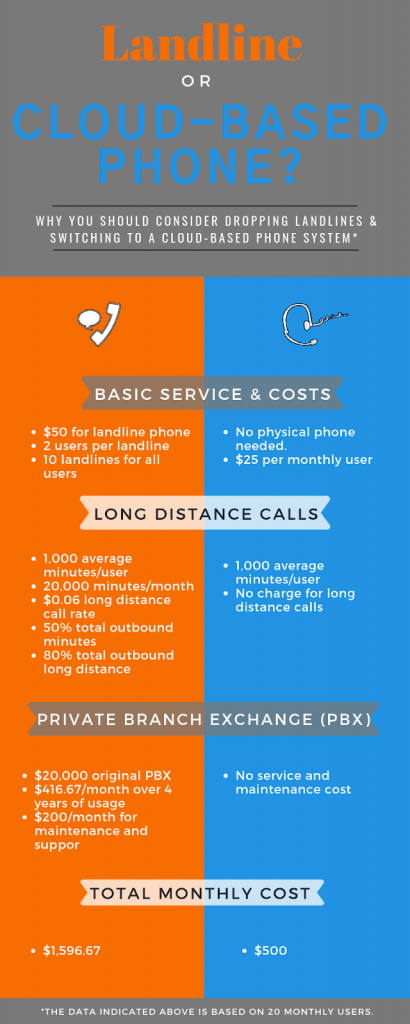
Cloud-based phones are subscription-based phone services you can purchase online. As far as cost savings and usage optimization are concerned, it outranks a traditional phone system significantly. In fact, a study has revealed that small businesses that switched to cloud-based phones saved 40% on local call costs and 90% on long-distance calls.
The following illustrates the stark contrast between using a landline and cloud-based phone:
Here are 8 popular cloud-phone systems you might want to try:
- Vonage for Business
- Dialpad
- ShoreTel Sky
- Mitel
- Jive
- 8×8
- OnSip
- RingCentral
4. Travel for business economically.
Business travel is inevitable. As a business owner, you need to attend conferences or seminars to expand your network and industry skills. You might also need to meet with a business coach or partner to help you become a more strategic manager and entrepreneur. If you’re gearing up to expand your brand, traveling to meet with and pitch to investors also takes an important place in your agenda. Apart from these, when you delegate tasks that require employees to travel, you are also expected to reimburse the expenses they incur along the way.
Thankfully, while business travel is unavoidable, it is also controllable. The following techniques will help you be more strategic and economical on travel expenses:
- Use credit cards that reward frequent travelers. When used strategically, credit cards can help you make the most of your expenses. Many banks offer credit cards that reward users who accumulate points from online shopping and traveling. Take advantage of these rewards by booking airfare and hotel accommodations with credit cards. Rewards can come in the form of cash, room or flight upgrades, and even free airfare.
- Outline refundable items from the get-go. To discourage overspending, make sure your employees know what you can reimburse. Fare, room accommodations, and food are essentials. However, Business.com revealed that some employees also spend and expect refunds on less significant items, such as health club visits, room service, and minibars.
- Use AI for auditing expenses. Manual accounting is more tedious and prone to errors. That’s why it is wiser to ditch manual accounting and switch to AI or online tools when it comes to auditing your travel expenses. Apart from this, using technology for checking expenses also gives you a chance to catch unnecessary spending. AI systems have the power to cross-reference online platforms to verify the source as well as validity of expenses.
- Take time for self-education. While having an industry coach has advantages, it’s not the only way to learn how to increase business growth. There’s a myriad of books and online webinars especially dedicated for small business owners. Listening to podcasts or TedTalks for business while running errands will also help you gain industry and leadership insights without having to spend on fare or conference tickets.
5. Avoid late payments to avoid cash flow problems.
In a nutshell, cash flow refers to the movement of money in and out of business. Problems with cash flow happen when you get late or incomplete payments but still need to shell out money to keep your business running.
To ensure that your business cash flow runs smoothly, lessen the tendency or possibility of late payments from customers. Here’s what you can do:
- Get paid upfront. Make it a priority to collect payment upfront for your service. If this isn’t possible for some cases or clients, at least ask for a 50% non-refundable deposit to create a cash buffer.
- Offer different payment options. Are you only collecting cash payment? Make your services available to more customers by offering multiple payment options through credit or debit cards, online bank transfers, and PayPal.
- Reward full, on-time payments and penalize late ones. Encourage your customers to pay in full and on time by providing incentives such as rewards points or discounts for future purchases. Another way to do it is by charging delinquent customers with late fees on top of service costs.
- Send bills as soon as possible. If your line of business doesn’t have fixed service rates, it’s important to send out invoices as soon as you settle the service terms and fees with a client. If your company offers fixed rates for products or services, you can help customers pay on time by sending automated payment reminders. Tools like WaveApp, Kashflow, and Invoicely can help you automate invoice reminders. You can also set this up from Outlook or Gmail.
Driving new business development doesn’t also mean flashy campaigns and expensive tools. It can be as practical as knowing how to cut cost in a company. Start with these 5 simple ways to lessen your business operational expenses.
[/vc_column_text][/vc_column][/vc_row]
READ MORE
Content and Web Design: How They Go Hand-in-Hand

When you do a quick Google search for web content and web design, you’re likely to find several articles comparing the two and you probably end up trying to identify which is more important one.
Which should come first when you’re building your website or doing your email marketing? Should you design first and just add in some content that fits your design? Or do you create your content first and just pattern your design around it?
If you’re a content writer VA or a graphic designer VA, or even a bit of both, trying to mesh the content of your client’s website with the design that they want can be tricky. There’s a constant power play between the two, and more often than not, one or the other emerges as the dominant one.
Content and Design Should Complement Each Other
It’s very important to remember that your content and your design should complement each other instead of competing against one another. If you are a content writer and you want to develop a strategy that will help boost your client’s website ranking in Google or if you want to create emails that actually convert, you need to work closely with your client’s graphic designer to ensure that their design and your content mesh well together.
The same thing is true if you’re the graphic designer. It’s important that you know what your client’s content manager is aiming for with their content strategy so that you can craft a design that helps it work better.
Developing a Content and Design Strategy
Whether you’re in the content side of things or the design side of things, you’re definitely going to have your own strategy. But on top of your own strategy, you also need to have a plan that involves both the content and design branches.
Here are some tips on developing a content and design strategy.
-
Have a clear mission and goals.
It’s important that each member of both teams know and understand the mission and goals for your project so that your output can reflect that. It really helps unify the output when everyone is working towards a common goal.
-
Have a structured work process.
You need to have specific steps in the design and content creation process so that neither the content nor the design team is floundering when it comes to who’s turn it is to work on a particular task or who to submit their output to for opinions, etc. This also helps everyone be more efficient and meet all their deadlines.
-
Have regular brainstorming and feedback sharing sessions.
The key to working well together is maintaining an honest, open environment and ensuring constant communication. Scheduling weekly or monthly sessions to ensure that everyone’s on track, brainstorming new ideas, or just getting feedback on whatever you’re working on at the moment is really helpful.
When it comes to content and web design, it’s really important to have a system in place that allows each aspect of the digital marketing process to interact freely with each other and help each other successfully pursue their goals. Content and web design always go hand-in-hand, so content writers and graphic designers working closely together is essential.
READ MORE